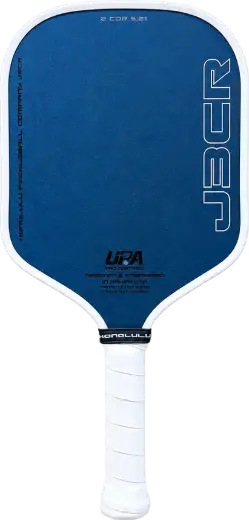
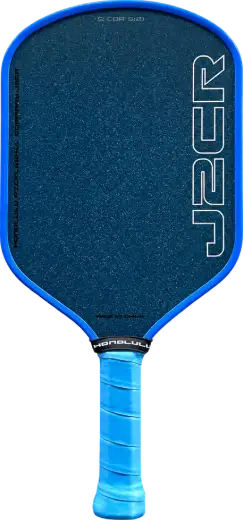
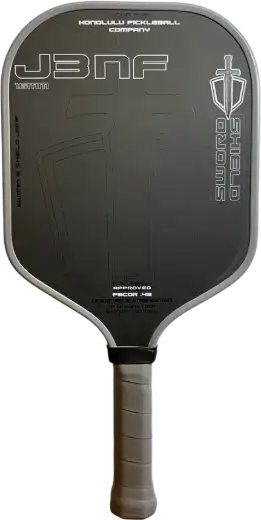
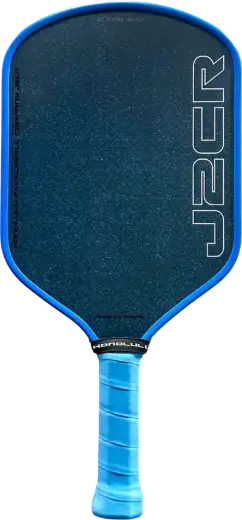
The Honolulu J3NF is the J3 I'd get if you play USA Pickleball events, hit a two-handed backhand and want a widebody that feels dense and comfortable instead of stiff and hollow. It's a 16mm full foam widebody with a raw carbon face, and it's the J3 shape of Honolulu's 2025 NF line, with the same shape and 6 inch handle as the newer J3CR and J3CR Crystal Blue. On my numbers it plays like a balanced all-court widebody. It scored 70 out of 100 for power, a little more than the average widebody, and its pop, spin, sweet spot and control all come out about the same as the average widebody. What sets it apart from the CR versions is feel, because the J3NF plays denser and quieter. It isn't the strongest J3, though. At the same price, the J3CR Crystal Blue hits clearly harder and spins far more, but it's approved by UPA-A only. UPA-A is the paddle approval list used for pro tour events, and a UPA-A only paddle isn't legal in USA Pickleball sanctioned events. As of October 22, 2026, you can order the J3NF on 808pickle.com in black. It's $195, or $175.50 with code STS10. I earn a commission when you use my codes.
Pros and cons
Pros
- Its 6 inch handle has room for two hands, and only three other widebodies I've tested have a handle that long. Two of them are Honolulu's J3CR and J3CR Crystal Blue.
- It plays dense and comfortable, with quieter contact than the stiff, hollow J3CR Crystal Blue.
- It scored 70 out of 100 for power, a little more than the average widebody's 64.5, and 77 out of 100 for control, about the same as the average widebody's 76.
- It's approved by USA Pickleball, so it's legal in USA Pickleball sanctioned events.
Cons
- Its twist weight, which is how much the face resists twisting when you miss the center, came in at 6.73. That's lower than the average widebody's 6.92, and 46 widebodies I've tested have a higher one, so the face turns more on mishits than it would on most widebodies.
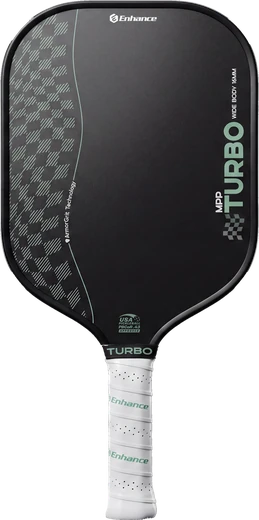
- It scored 70 out of 100 for power, a little less than the average 16mm full foam widebody's 78. The Enhance MPP Turbo Widebody has clearly more power, 80 against 70, for $75.51 less with the codes.
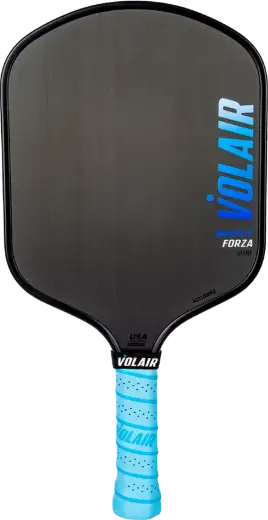
- It read 2,270 RPM in my spin test, about the same as the average widebody. The J3CR Crystal Blue spins far more, at 2,436 RPM.
- It isn't approved by UPA-A, so you can't use it in UPA-A events like PPA qualifiers.
Quick answers
Is the Honolulu J3NF USA Pickleball approved?
Yes. Honolulu sells it as the Sword & Shield J3NF, and on October 22, 2026, USA Pickleball's approved paddle list showed the Sword & Shield J3NF, added August 11, 2025. Honolulu's product page shows the USA Pickleball approved badge too. It isn't approved by UPA-A, so it works in USA Pickleball sanctioned events but not in UPA-A events like PPA qualifiers.
J3NF or J3CR?
Both have the same shape, the same 6 inch handle, the same $195 price and USA Pickleball approval, so the difference is the core and the feel. The J3CR has clearly more pop, 91 out of 100 against 80 on the J3NF, and a little more power, 78 against 70. Spin, sweet spot and control come out about the same. The J3NF swings a little lighter, with a swing weight of 110.1 against 112.2 on the J3CR. Swing weight is how heavy the paddle feels when you swing it, lower means faster hands. The J3CR also plays stiffer and hollower. The J3NF is the one I'd get, for its denser, quieter feel and less pop to manage at the kitchen. If you want more pace than the J3NF gives you, I'd look at the J3CR Crystal Blue if UPA-A paddles are allowed where you play, or the Enhance MPP Turbo Widebody if you need USA Pickleball approval.
J3NF or J2NF?
Same NF build and the same $195 price, so it comes down to shape and handle. The J2NF hybrid hits a little harder, with a power score of 77 out of 100 against 70 on the J3NF, and the J3NF has a little more pop, 80 against 74. Spin, control and swing weight come out about the same. The sweet spot is about the same too, 82 out of 100 on the J3NF against 79 on the J2NF, so the widebody shape doesn't buy you much extra forgiveness here. Get the J3NF if you want a 6 inch handle for a two-handed backhand, since the J2NF's 5.5 inch handle is enough for a two-handed backhand, but tight. Get the J2NF if you want a little more power in a hybrid.
Is the J3NF good for beginners?
It works, but it isn't where I'd start a beginner. Its control score of 77 out of 100 is only about average for a widebody, and its below average twist weight lets the face turn more on mishits. A newer player in USA Pickleball events is better off with the Selkirk SLK Dauntless Widebody, which scored 89 out of 100 for control, clearly more than the J3NF.
Dense and comfortable, where the J3CR Crystal Blue is stiff and hollow
So, the J3NF plays dense and comfortable. It has a medium plush foam feel with enough feedback that you still know where you hit the ball, and the ball comes off the face in a predictable way. It's quieter and denser than the hollow foam power paddles, like the Selkirk Boomstik and the original Bread & Butter Loco, which both feel stiffer too.
That's the biggest difference from the CR versions of the J3. The J3CR Crystal Blue plays stiff and hollow, with a clear crack at contact. The J3NF is less stiff and denser, so contact feels quieter and more muted in your hand. If you've tried a CR paddle and found it too loud or too lively, the J3NF is the J3 that fixes that.
Pop is the pace the ball picks up off a short, quick swing. The J3NF scored 80 out of 100 for pop, about the same as the average widebody's 78.5. So blocks and counters come off with some pace, but the face doesn't jump off the ball.
Its swing weight came in at 110.1, about the same as the average widebody's 108.8. That makes it neither quick nor slow for a widebody.
It plays like an all-court widebody, with a little extra pace
How its spin stacks up against other widebodies you can buy
About average spin for a widebody, right at the average
The top three for spin
- 1Honolulu J3CR Crystal Blue2,436
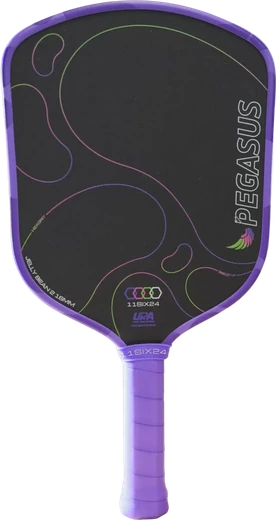
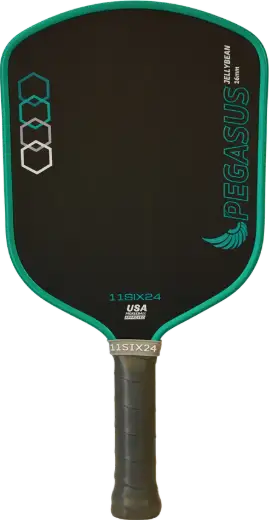
- 211SIX24 Pegasus Jelly Bean 22,37561 RPM behind
- 3RPM Q2 Widebody2,36967 RPM behind
- 25Honolulu J3NF2,270166 RPM behind
Drives and serves
The J3NF gives you real pace for a widebody without being a power paddle. It scored 70 out of 100 for power, a little more than the average widebody's 64.5. The core type explains where it lands. The average 16mm full foam widebody scores 78 for power, so the J3NF hits a little softer than most foam widebodies, and only eight full foam widebodies I've tested score lower for power. The average 16mm honeycomb widebody scores 50 for power, so the J3NF has far more pace than that.
Spin is about average. The J3NF read 2,270 RPM in my spin test, for a spin score of 71 out of 100, about the same as the average widebody at about 2,273 RPM. That's what you'd expect from a raw peel-ply carbon face, and it won't give your topspin drives the extra dip a grit face like Crystal Blue does.
Speed-ups, counters and hands battles
With pop about average and a swing weight about average for a widebody, the J3NF holds its own in a hands battle without winning it for you. A counter gets decent pace off a compact swing. If you want more pop in fast exchanges, the Enhance MPP Turbo Widebody gives you a little more, 85 out of 100 against 80, along with clearly more power.
Dinks, resets and third-shot drops
Control is my score from the same ball-machine dink, drop and reset drills every paddle gets. The J3NF scored 77 out of 100 for control, about the same as the average widebody's 76. With average pop and a predictable response, a reset you push doesn't take off on you. It's a comfortable soft game, but it isn't a control paddle.
Mishits
The sweet spot scored 82 out of 100, about the same as the average widebody's 83. So the hitting area is about what you'd expect from the shape, and no bigger.
The catch is twist weight. The J3NF measured a twist weight of 6.73, lower than the average widebody's 6.92, and 46 widebodies I've tested have a higher twist weight. So when you miss toward the edge, the face turns in your hand more than it would on most widebodies. That's the J3 shape, not the NF core, since the J3CR measured 6.74 and the J3CR Crystal Blue measured 6.73. Honolulu lists a twist weight of 6.8 to 7.1, so a few grams of lead tape at 3 and 9 o'clock brings the J3NF's 6.73 up toward that range. With a swing weight of 110.1, it has room for the extra weight.
How it feels in your hand next to other widebodies you can buy
About average in your hands, a little less steady when you miss the middle
How heavy the paddle feels when you swing it. A lower number swings quicker.
About average swing weight for a widebody.

How much the paddle fights twisting when you miss the middle. A higher number is steadier.
Less steady than most widebodies.
How its sweet spot stacks up against other widebodies you can buy
An average-size sweet spot for a widebody
Both rings are sized to their score.
Same J3 shape and handle as the J3CR, with Honolulu's earlier NF core
Honolulu lists a 16mm multi-density foam core, with an EPP center and an EVA perimeter. Over that is a carbon fiber and fiberglass face with a carbon fiber top layer, and the paddle is thermoformed with perimeter balancing. Honolulu calls the J3NF's technology Connected Reflex.
On paper, the J3CR lists nearly the same build, with what Honolulu calls Core Reactor technology in place of Connected Reflex. Honolulu doesn't spell out what changed in the core, but my numbers show the result. The J3CR has clearly more pop and a little more power than the J3NF, with about the same spin, sweet spot and control.
The face is raw peel-ply carbon with no grit. Next to the average 16mm widebody with a raw peel-ply face, which comes in at 2,265 RPM, the J3NF spins about the same.
Honolulu lists it at 7.9 to 8.3 oz, 16 inches long and 8 inches wide. It lists a swing weight of 108 to 113, and I measured 110.1. The handle is 6 inches including the tapered part and grip wrap. The grip is 4.125 inches around. That leaves room for a two-handed backhand. Only three other widebodies I've tested have a handle that long, and two of them are Honolulu's J3CR and J3CR Crystal Blue. The warranty is one year, and Honolulu includes a cover with a hanging clip.
Owners have been quiet on the J3NF
Honolulu opened J3NF pre-orders on August 12, 2025, so it's been on sale for about 14 months. As of October 22, 2026, I haven't found an owner report on the J3NF, good or bad, so there's no long-term owner track record on it yet.
J3NF or J3CR Crystal Blue?
The J3CR Crystal Blue is the paddle I'd weigh the J3NF against first. Both have the same J3 shape, the same 6 inch handle, the same one year warranty and the same price, $195, or $175.50 with code STS10. The face, the feel and the approval decide it.
On my scores, the J3CR Crystal Blue is the stronger paddle. It read 2,436 RPM in my spin test against 2,270 on the J3NF, so it spins far more. In my wear test, Honolulu's Crystal Blue surface lost about 1% of its spin over 75 games. It has clearly more power, 81 out of 100 against 70, and a little more pop, 86 against 80. Sweet spot and control come out about the same, and both measured a twist weight of 6.73. The J3CR Crystal Blue also swings a little lighter, with a swing weight of 108.1 against 110.1 on the J3NF.
The feel is where the J3NF wins you back. The J3CR Crystal Blue plays stiff and hollow with a clear crack, and the J3NF plays denser and quieter, with a more comfortable feel in your hand.
The approval may make the choice for you. The J3NF is approved by USA Pickleball, and the J3CR Crystal Blue is approved by UPA-A only, so the J3CR Crystal Blue isn't legal in USA Pickleball sanctioned events.
So if UPA-A paddles are allowed where you play, get the J3CR Crystal Blue. If you play USA Pickleball events and want the denser feel, get the J3NF. And if you play USA Pickleball events and want more pace, the Enhance MPP Turbo Widebody has clearly more power for $75.51 less with the codes.
Where I'd look instead, for more forgiveness, more control or less money
Two paddles you might pick instead
How it stacks up against the MPP Turbo Widebody and the Pegasus Power
A paddle only wins a score when it leads by 5 points or more.
 J3NFWidebody · $175.50
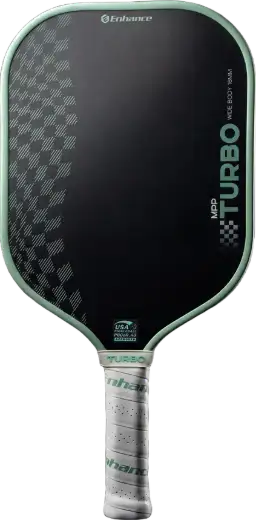 MPP Turbo WidebodyWidebody · $99.99
The MPP Turbo hits harder, has more pop and a bigger sweet spot. Spin and control are about the same. The MPP Turbo costs about $75 less.
J3NFWidebody · $175.50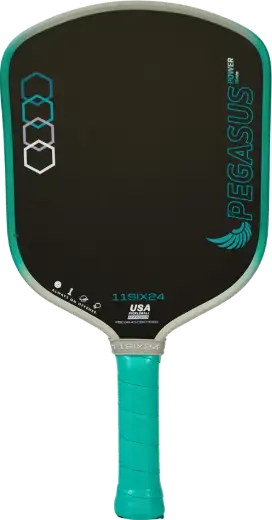 Pegasus PowerWidebody · $89.99
The J3NF hits harder and has more pop. The Pegasus Power spins more, has a bigger sweet spot and is more controllable. The Pegasus Power costs about $85 less.
Enhance MPP Turbo Widebody, $119.99, or $99.99 with code STSPICKLEBALL. This is the one I'd get if you don't need a 6 inch handle. It's $75.51 less with the codes, and it beats the J3NF on pace and forgiveness. It has clearly more power, 80 out of 100 against 70, a little more pop, 85 against 80, and a clearly bigger sweet spot, 92 against 82. Spin and control come out about the same. It swings a little lighter, with a swing weight of 106.9 against 110.1, and its twist weight is higher, 6.93 against 6.73. It's USA Pickleball approved, its 5.3 inch handle is tight for two hands, and Enhance's one year warranty covers just the core.
11SIX24 Pegasus Power, $99.99, or $89.99 with code STSPICKLEBALL. This is the honeycomb Pegasus Power, not the Pegasus Power 2, and it's the one for soft-game players on a budget. It's $85.51 less with the codes. It has a clearly bigger sweet spot, 97 out of 100 against 82, and clearly more control, 88 against 77. You give up a little pace, with a little less power, 64 against 70, and a little less pop, 74 against 80. Spin and swing weight come out about the same. It's USA Pickleball approved, its 5.5 inch handle is enough for a two-handed backhand, but tight, and the warranty is six months.
Selkirk SLK Dauntless Widebody, $150. The code INF-STSPICKLEBALL doesn't lower the price, but it adds a $20 Selkirk gift card to your order. It's $25.50 less than the J3NF with code STS10. This is the one if you want a soft, dense feel with more control. It scored 89 out of 100 for control, clearly more than the J3NF's 77, and it has a little bigger sweet spot, 89 against 82. You give up a lot of pace, with far less power, 50 against 70, and clearly less pop, 70 against 80. It also spins less, 2,185 RPM against 2,270. Swing weight is about the same. It's USA Pickleball approved, its 5.6 inch handle is enough for a two-handed backhand, but tight, and the warranty is one year.
Get it if you want a dense J3 for USA Pickleball play, and skip it if you want more pace for your $195
Play USA Pickleball events, hit a two-handed backhand and want a widebody that feels dense and comfortable instead of stiff and hollow? The J3NF is the one I'd get.
Skip it if UPA-A paddles are allowed where you play, because the J3CR Crystal Blue hits clearly harder and spins far more. And skip it if you want more pace and don't need a 6 inch handle, because the Enhance MPP Turbo Widebody gives you clearly more power and a clearly bigger sweet spot for $75.51 less with the codes.
Testing details
- Tested
- June 10, 2026
- Power and pop
- 20 full serves for power and 20 punch volleys for pop, every ball speed read on a Stalker radar gun.
- Spin
- 20 more serves on the radar. I drop the outliers and average the rest, which gave this paddle 2,270 RPM.
- Swing and twist weight
- Measured on a Briffidi SW1 swing weight machine.
- Sweet spot and control
- The same dinks, drops, resets and drives off a Titan ONE ball machine, for every paddle.
- The scores
- Out of 100, with the same tests for every paddle. The top paddles I've tested score 100.
- Published
- Scores from
- My database, updated October 21, 2026. How I test
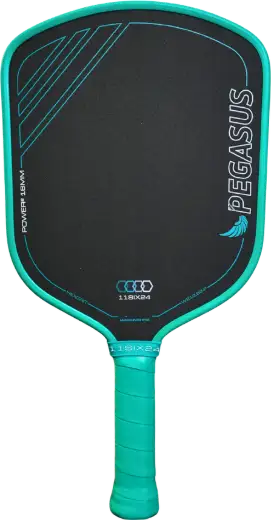
 No. 1
 No. 2
 No. 3