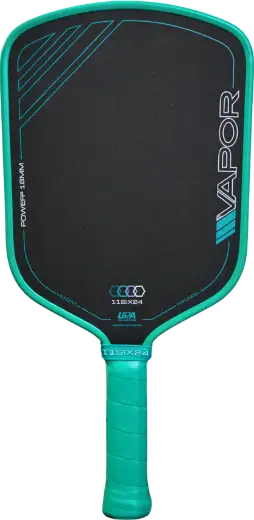
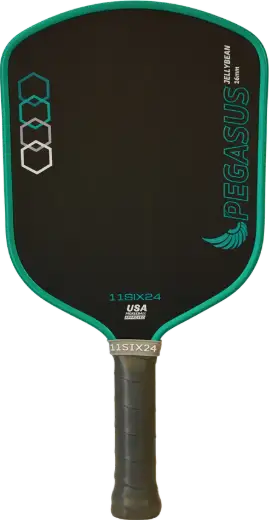
The 11SIX24 Pegasus Jelly Bean 2 is a full foam widebody, and it's soft and quiet when you hit it. It's made for players who win their points at the kitchen. It takes pace off the ball, which helps your dinks and resets stay low. It also has more spin than almost every other widebody I've tested. What you give up is power. With the Jelly Bean 2, you make most of your own pace. So the question to ask yourself is whether you win points with touch and spin, or with pop and put-aways. If it's touch and spin, the Pegasus Jelly Bean 2 is my pick, because no widebody that costs less matches it on both spin and sweet spot. It's $169.99, or $159.99 with the code STSPICKLEBALL.
Pros and cons
Pros
- The Pegasus Jelly Bean 2 is the only paddle I've tested with 85 or higher for control, spin and sweet spot all at once.
- It scored 94 out of 100 for spin, and only one widebody I've tested spins more.
- The soft foam core takes pace off the ball, so fewer of your dinks and resets pop up high.
- In my wear test, HexGrit, the grit 11SIX24 builds into the face, lost about 1% of its spin over 75 games.
Cons
- Power is low for a full foam paddle, so you need a full swing to get real pace on your drives and serves.
- It doesn't add much pace on speed-ups and counters, so in a fast hands battle the effort has to come from you.
- It's UPA-A approved only, so you can't use it in USA Pickleball sanctioned events.
- It's soft and quiet at contact, so it's not for players who want a stiff, loud paddle.
Quick answers
Is the Pegasus Jelly Bean 2 worth $169.99?
For a player who wins with touch and spin, yes. No widebody that costs less gives you both its spin and its sweet spot.
Should I get the Pegasus or the Vapor Jelly Bean 2?
For the most room for error, go with the Pegasus widebody, because the other three Jelly Bean 2 shapes, the Vapor and Ultré hybrids and the Hurache-X elongated, all have a far smaller sweet spot. The two hybrids have about the same spin but are clearly less controllable, and the Hurache-X hits clearly harder but is far less controllable.
Should I upgrade from the original Pegasus Jelly Bean?
Yes, if you want more spin and pace, since the Jelly Bean 2 has far more spin, far more power and clearly more pop for $70 more, with about the same sweet spot and a little less control. But the original is USA Pickleball approved and the Jelly Bean 2 is UPA-A only, so if you enter USA Pickleball sanctioned tournaments, hang on to the original.
Soft and quiet, and it takes the pace off hard balls
The Pegasus Jelly Bean 2 is a soft paddle. When you hit it, the ball sinks into the paddle face before it comes off, and contact never feels stiff. The Jelly Bean 2 gets its soft feel from its EMA foam core.
It's quiet too. If you like to hear the ball crack off the face and feel every hit in your hand, the Jelly Bean 2 will feel a little dead to you. A Honolulu J2FC+ or an Engage X2 lets you feel more of each hit.
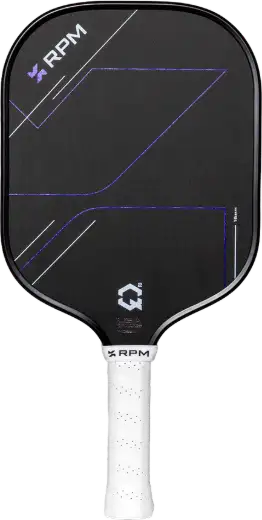
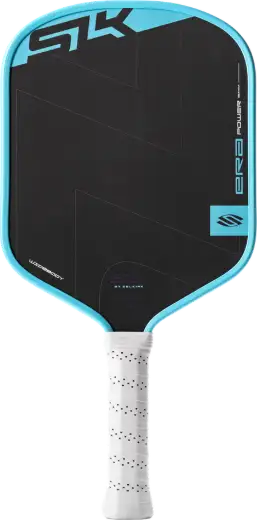
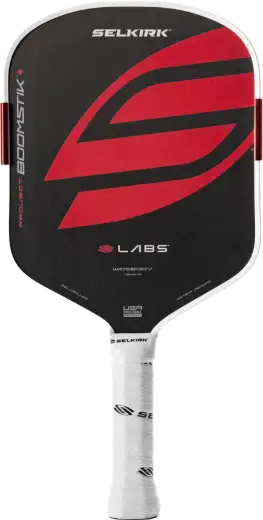
Pop is the pace the ball gets on short swings, like punch volleys and counters. On those swings, the ball doesn't jump off the Jelly Bean 2's face, and when a hard ball comes at you, the paddle takes pace off it. The RPM Q2 Widebody has far more pop than the Jelly Bean 2, and the Selkirk Boomstik Widebody has clearly more.
You get what you swing with the Jelly Bean 2, and the ball never comes off hotter than you meant it to. Just know that if you're coming from a really poppy paddle, your shots will come up short of where you aimed for the first few games, until your swing gets used to it.
Strong at the kitchen, weak in fast hands battles
How its spin stacks up against other widebodies you can buy
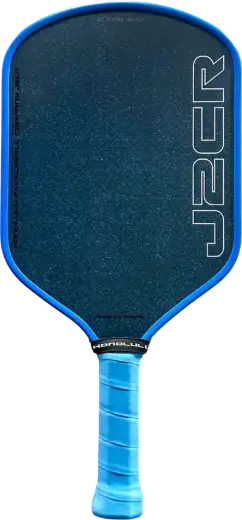
Only one widebody you can buy spins more, 102 RPM above the average
The top three for spin
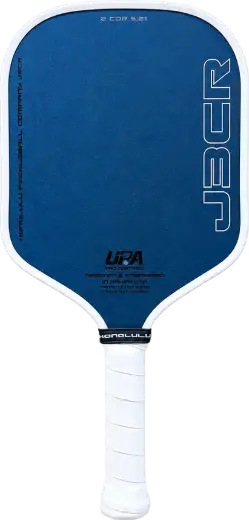
- 1Honolulu J3CR Crystal Blue2,436
- 211SIX24 Pegasus Jelly Bean 22,37561 RPM behind
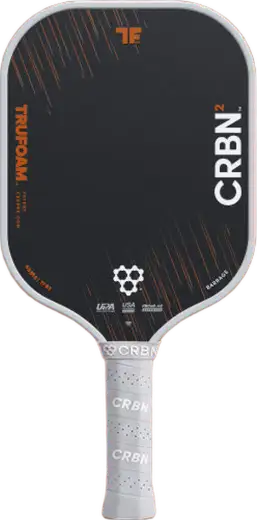
- 3RPM Q2 Widebody2,36967 RPM behind
Drives and serves
You can hit a hard drive with the Pegasus Jelly Bean 2, but only with a full swing. It scored 63 out of 100 for power, so most of the paddles I've tested hit harder. A power score of 63 is about average for a widebody, but it's clearly low next to the average 16mm full foam widebody. On a short, compact swing, the Jelly Bean 2 doesn't give you much easy power.
Spin is where the Jelly Bean 2 makes up for the lower power. It came in at 2,375 RPM, which scored a 94 for spin. The HexGrit surface grips the ball really well, so you can put a lot of topspin on your serves and drives.
Hands battles
Hands battles are the Jelly Bean 2's weak spot. On speed-ups and counters, the Jelly Bean 2 doesn't add much pace, so the effort all has to come from you. If you like to win fast exchanges at the net with short, quick swings, the Jelly Bean 2 will let you down. Keep in mind the Pegasus Jelly Bean 2 also swings heavy for a widebody. Only eight widebodies I've tested swing heavier.
On defense, it's a different story. When the other team speeds the ball up at you, the Jelly Bean 2 soaks up the pace, so your blocks are a lot easier to control, and so are your short punch volleys.
The Jelly Bean 2 is weak on put-aways too. It has enough pace to finish points, but you have to really swing for every one.
The kitchen
The kitchen is where the Pegasus Jelly Bean 2 is at its best. On dinks, the ball comes off soft and the HexGrit surface grips it, so fewer of your dinks float up high enough to get attacked. It's really good in long dink rallies, and you can roll topspin dinks without much worry.
Resets are a strength too. The soft foam core takes the pace off a hard ball, so your resets have more room for error. If your resets tend to sit up too high, the Jelly Bean 2 will help a lot. But you have to give each reset a little push yourself. If you like to hold the paddle still and let the ball bounce off the face and over the net, the Jelly Bean 2 won't do that for you. After a few games you'll know how much push to give it.
Third-shot drops are a real strength, and that includes drops you hit hard with a lot of topspin. The ball comes off the Jelly Bean 2 slower than it would off a poppy paddle like the Pegasus Power 2, the power version of this same widebody. That makes it easier to land your drops low in the kitchen.
Mishits
The Pegasus Jelly Bean 2 is forgiving when you miss the center. Its sweet spot is a little bigger than the average widebody. Just know that on an off-center hit, the ball loses a little more pace than it would off a stiffer paddle like the Pegasus Power 2, so your mishits come up a little shorter.
How it feels in your hand next to other widebodies you can buy
Heavier in your hands, about average when you miss the middle
How heavy the paddle feels when you swing it. A lower number swings quicker.
Swings heavier than most widebodies.
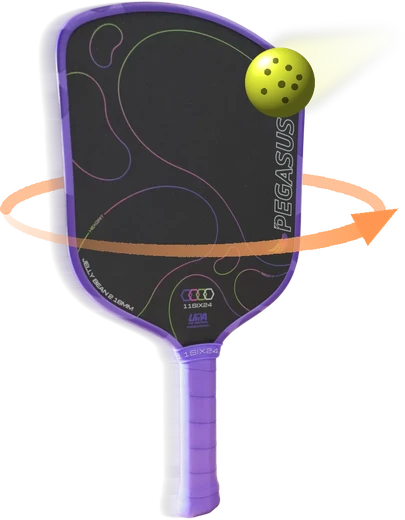
How much the paddle fights twisting when you miss the middle. A higher number is steadier.
About average twist weight for a widebody.
How its sweet spot stacks up against other widebodies you can buy
Only seven widebodies you can buy have a bigger sweet spot
Both rings are sized to their score.
A full foam build with honeycomb-level control
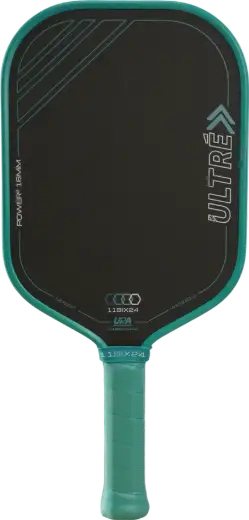
The Pegasus Jelly Bean 2 is a 16mm full foam paddle with an EMA foam core and 11SIX24's HexGrit surface. The 5.5 inch handle leaves room for a two-handed backhand. It's only on the UPA-A approved list. It isn't USA Pickleball approved. The warranty is one year.
11SIX24 lists the swing weight at 109 to 112 and the twist weight at 7.1 to 7.3. I measured 112.5 for swing weight and 6.92 for twist weight, so swing weight came in just over the listed range and twist weight came in under it.
If you're coming from a honeycomb paddle, the Jelly Bean 2 gives you about the same control as the average 16mm honeycomb widebody in my database, with clearly more power and clearly more pop. Next to the average 16mm full foam widebody, the Jelly Bean 2 has clearly less power and pop, but it's clearly more controllable. So you get the control of a honeycomb paddle, with more pace.
The Jelly Bean 2 also spins far more than the average 16mm widebody with a raw peel-ply face, and about the same as the average 16mm widebody with a grit surface.
Owners love the touch and wish it had more pace
11SIX24 released the Pegasus Jelly Bean 2 on August 21, 2026. When I went through owner reports in September 2026, people had only had it for about a month.
What owners love most is the soft feel and the touch it gives them on resets and dinks. Owners of the Pegasus shape also like the big sweet spot, and they say the paddle holds steady when they miss the center.
The main complaint is power and pop. Some owners say it plays like a control paddle, and they wish it had more pace.
As of my September 2026 check, about a month after it first shipped, I haven't found a defect that three or more owners report.
A month of owner reports shows that these likes and complaints are real, but not how common they are. It also can't tell you anything yet about how the Jelly Bean 2 holds up over time.
Should you get the Jelly Bean 2 or the Power 2?
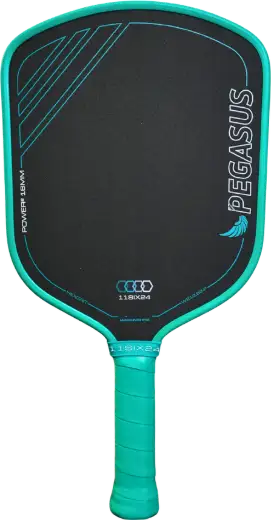
People compare the Pegasus Jelly Bean 2 to the 11SIX24 Pegasus Power 2 more than to almost any other paddle. The Power 2 is $209.99, or $199.99 with the code STSPICKLEBALL, so it costs $40 more. 11SIX24's own line is that the Power 2 "hits" and the Jelly Bean 2 "plays." The Power 2 is built to hit the ball hard, and the Jelly Bean 2 is built to win the soft game.
The biggest difference you'll notice is the feel. The Power 2 is stiff, and you hear a hollow crack at contact. The Jelly Bean 2 is soft and quiet.
The Power 2 has far more power and far more pop, and its sweet spot is a little bigger. The Jelly Bean 2 is clearly more controllable, and it swings a little heavier than the Power 2. Spin is about the same.
Both paddles are Pegasus widebodies with the HexGrit surface. Both are UPA-A approved only, and both come with a one year warranty.
If your problem is dinks and resets that pop up, get the Jelly Bean 2. If your problem is put-aways that the other team keeps getting back, get the Power 2.
Two cheaper options, plus one that costs more
Two paddles you might pick instead
How it stacks up against the MPP Turbo Widebody and the Mach 2 Forza
A paddle only wins a score when it leads by 5 points or more.
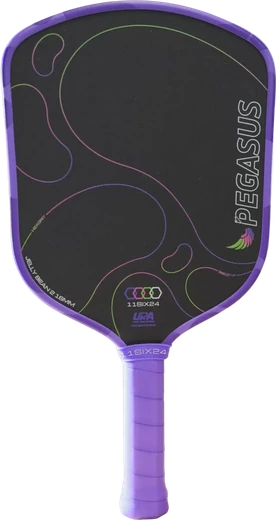 Pegasus Jelly Bean 2Widebody · $159.99
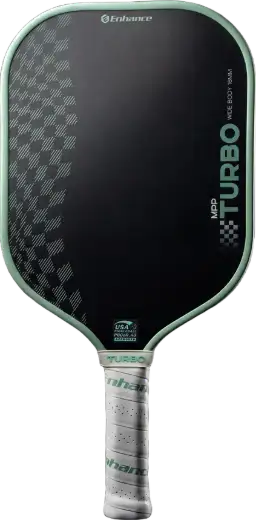 MPP Turbo WidebodyWidebody · $99.99
The Pegasus Jelly Bean 2 spins more and is more controllable. The MPP Turbo hits harder and has more pop. Sweet spot is about the same. The MPP Turbo costs about $60 less.
Pegasus Jelly Bean 2Widebody · $159.99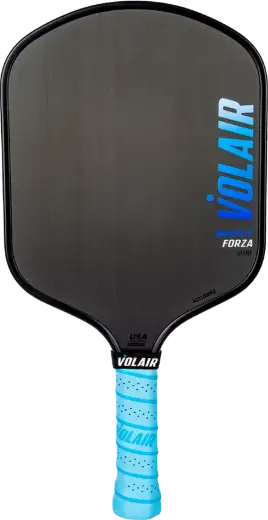 Mach 2 ForzaWidebody · $107.99
The Pegasus Jelly Bean 2 hits harder, has more pop and spins more. The Mach 2 Forza is more controllable. Sweet spot is about the same. The Mach 2 Forza costs about $52 less.
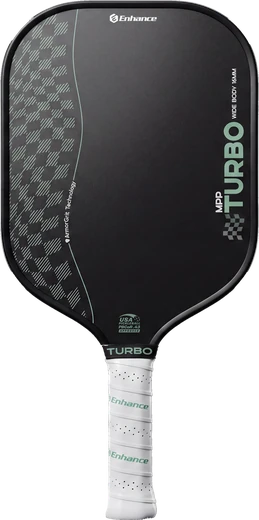
Enhance MPP Turbo Widebody, $119.99, or $99.99 with code STSPICKLEBALL
The Enhance MPP Turbo Widebody is my budget pick. It's $50 less than the Jelly Bean 2 at list price, and $60 less when you use the codes. It's for players who want more pace for less money and need a paddle that's USA Pickleball approved. The MPP Turbo Widebody has clearly more power and clearly more pop than the Jelly Bean 2, with about the same size sweet spot. What you give up is spin and control. The MPP Turbo Widebody has far less spin, and it's clearly less controllable. It also has a raw peel-ply face instead of a grit surface, and its 5.3 inch handle is tight for a two-handed backhand.
Volair Mach 2 Forza 16mm, $119.99, or $107.99 with code STSPICKLEBALL
The Volair Mach 2 Forza is for the pure control player who wants as much control at the kitchen as possible, and it's USA Pickleball approved. It's $50 less than the Jelly Bean 2 at list price, and $52 less with the codes. The Mach 2 Forza is clearly more controllable than the Jelly Bean 2, with the same size sweet spot. What you give up is power and spin. The Mach 2 Forza has far less of both, and a little less pop. It's a honeycomb paddle with a raw peel-ply face.
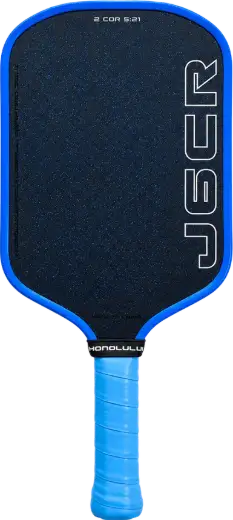
Honolulu J3CR Crystal Blue, $195.00, or $175.50 with code STS10
The Honolulu J3CR doesn't save you money. It's about $25 more than the Jelly Bean 2 at list price, and about $16 more with the codes. It's for players who want spin like the Jelly Bean 2's, but with more pace. The J3CR has clearly more power and clearly more pop, and more spin. What you give up is control and sweet spot. The J3CR is clearly less controllable, and its sweet spot is a little smaller. Like the Jelly Bean 2, it's UPA-A approved only. It also has a longer 6 inch handle.
Get it if touch and spin win your points
The Pegasus Jelly Bean 2 is my pick for players who win their points at the kitchen and want spin. No other paddle I've tested gets 85 or higher for control, spin and sweet spot all at once. Just know you'll have to swing for your pace, and it won't do much for you on offense in a fast hands battle.
If you win your points with pace and put-aways, get the Pegasus Power 2 instead. And if you play USA Pickleball sanctioned events, the Jelly Bean 2 isn't approved for them, so look at the Enhance MPP Turbo Widebody or the Volair Mach 2 Forza.
Testing details
- Tested
- August 13, 2026
- Power and pop
- 20 full serves for power and 20 punch volleys for pop, every ball speed read on a Stalker radar gun.
- Spin
- 20 more serves on the radar. I drop the outliers and average the rest, which gave this paddle 2,375 RPM.
- Swing and twist weight
- Measured on a Briffidi SW1 swing weight machine.
- Sweet spot and control
- The same dinks, drops, resets and drives off a Titan ONE ball machine, for every paddle.
- The scores
- Out of 100, with the same tests for every paddle. The top paddles I've tested score 100.
- Published
- Scores from
- My database, updated October 15, 2026. How I test
 No. 1
 No. 3
 No. 1
 No. 2
 No. 1
 No. 3