How I test every paddle
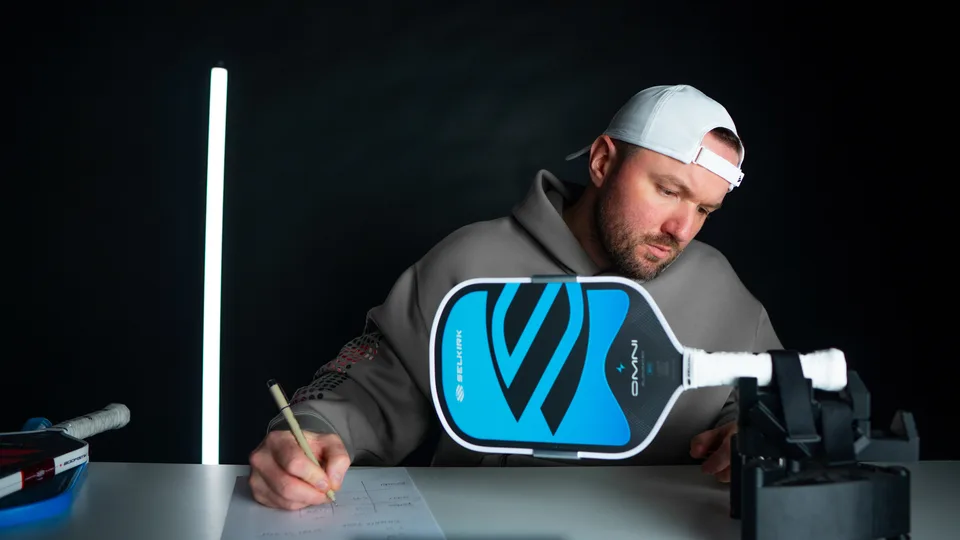
Every paddle on this site goes through the same tests, done by me: a radar gun for power, pop and spin, 20 shots for each, a swing weight machine for swing weight and twist weight, and ball machine drills for sweet spot and control.
Brands send me paddles free. I earn a commission when you buy through my links or codes. Neither one moves a score.
- I've tested hundreds of paddles
- 30 brands
- Database updated October 15, 2026
 Tested and written by Steven ShiplerUpdated October 4, 2026 · About me
Two kinds of numbers
Measured
Read off an instrument, the same way every time: power, pop, spin, swing weight, twist weight, balance point and size.
Rated by me
Sweet spot and control. I rate these from the same ball machine drills on every paddle, against every other paddle I've run through them.
The gear
- Stalker Sport Pro 3s radar gun
- Reads ball speed in mph and spin in RPM. It gives me power, pop and spin.
- Briffidi SW1
- A swing weight machine. It measures swing weight, and with its twist weight adapter, twist weight.
- Titan ONE ball machine
- Feeds every paddle the same drills, so I can rate sweet spot and control paddle against paddle.
- Balance point testing
- I find each paddle's balance point and measure its length, width, handle length and grip size.
- Starrett SR160
- A surface roughness tester. A diamond stylus reads how rough a paddle face is, in micrometers.
- Digital microscope
- For a close look at the grit itself.
What each test measures
Power and pop
Power is how hard the ball comes off the paddle on a full swing. Pop is the pace on a short punch volley at the net. Two paddles with the same power can still differ here, and you feel it in hands battles. I hit 20 serves for power and 20 punch volleys for pop, read the ball speed of every one in mph on the radar, and turn each set into a score out of 100.
Spin
Spin gets its own 20 serves, separate from the power serves. I read the spin on every one with the radar, throw out the outliers, and average the rest. That average is the RPM you see on every paddle, and the spin score follows it: no paddle with more RPM has a lower spin score.
Compare RPM between paddles on this site, not with USA Pickleball's limit. Their test uses a different setup.
Swing weight and twist weight
Swing weight is how heavy the paddle feels when you swing it. Lower means faster hands. Twist weight is how well the paddle resists turning in your hand when you hit off center. Higher means steadier.
Across every paddle I've tested, swing weight runs from 98.8 to 124.0, and a typical paddle reads about 113.2. Twist weight runs from 5.34 to 7.72, with a typical paddle about 6.47.
Balance point and size
I measure balance point in centimeters, plus length, width, handle length and grip size, and check them against what the brand lists. Every one I've checked has matched.
Sweet spot and control
On the Titan ONE I run dinks, drops, resets and drives, and I hit a lot of serves on each paddle too. Every paddle gets the same drills from the same machine, so when one paddle handles a drill better than another, the paddle is the difference.
Sweet spot is how well a ball you hit off center still goes where you aimed. Control is how easy it is to hit soft and keep the ball low. I rate both against every other paddle I've run through the same drills.
Grit
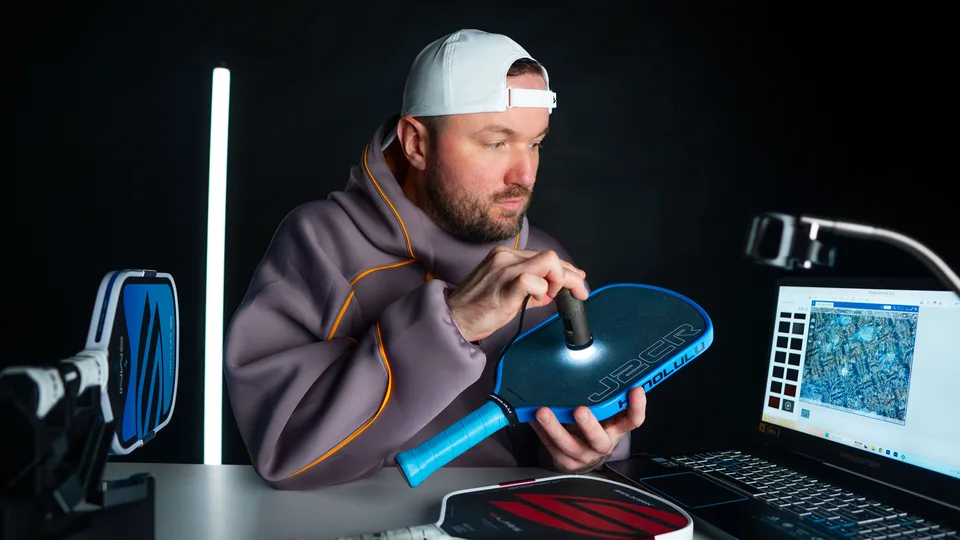
When I want to look closer at a grit, I read how rough the face is with the SR160 and look at the grit itself under the microscope. I don't publish roughness numbers.
To see how long grit lasts, I play on it. On my own paddles, HexGrit and Honolulu's Crystal Blue surface each lost about 1% of their spin after 75 games. Those are the only two grits I've put through that test, so I don't make claims about how long the others last.
How the scores work
Five of the numbers are scores out of 100: power, pop, spin, sweet spot and control. Every paddle is scored the same way. The top paddles on each score 100, and a typical paddle sits in the high 60s.
Swing weight, twist weight, spin RPM, balance point and size stay as readings, not scores.
The letters group the scores:
Compare a paddle with others of its own shape. A widebody's wider face usually scores higher on sweet spot and control. A typical widebody scores about 83 on sweet spot and 76 on control, a typical hybrid about 72 and 71, and a typical elongated paddle about 52 and 45. That's why my lists rank each paddle against its own shape.
Same test, every paddle
In the six months before the October 15, 2026 version of my database, I re-tested every paddle in it with the exact same tests, a handful each session, several days most weeks. So a 90 on one paddle means the same thing as a 90 on any other.
New paddles usually reach me before they launch. They go through the same tests, and my review goes up on launch day or within a week.
Method log October 15, 2026: database published after six months of re-testing every paddle in it on this method.
What the numbers can't tell you
- How a paddle feels in your hand. Two paddles can score the same and feel nothing alike. Each review covers how the paddle feels and plays.
- How it holds up after months of play, beyond the two grits I've wear tested.
- Whether it suits your game. The numbers narrow it down. The switch tool shows what you'd gain and give up against the paddle you play now.
Who pays for this
Brands send me paddles at no cost, with no obligation to review them and no say in what I write.
I earn a commission when you buy through my links or codes. That never moves a score or a rank.
No brand pays for a review, a ranking or a score.
See a number that looks wrong?
Tell me in the comments on any of my YouTube videos.