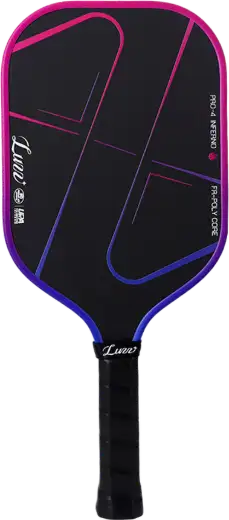
The Luzz Cannon is a budget elongated that hits as hard as JOOLA's 16mm Perseus Pro IV and spins a lot more, for about $50 less. It's a Gen 3 paddle made much like the Pro IV, with a honeycomb core and foam sealed inside a one-piece thermoformed shell, and it feels crisp. I'd get it if you love that feel or you need approval from both USA Pickleball and UPA-A, which PPA and MLP pro events go by. No other power paddle under $100 has both.
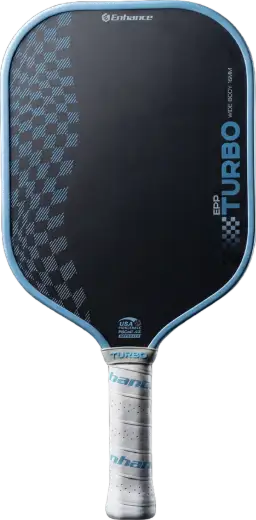
The catch is that it isn't very forgiving. Its sweet spot is small and its control is a good bit under average, so you need good touch on your dinks and resets. If you don't need UPA-A or that honeycomb feel, I'd get Enhance's MPP Turbo ArmorGrit Elongated instead. That's my No. 1 paddle under $100, and it beats the Cannon on every score for about two dollars more.
Pros and cons
Pros
- It has the 16mm Pro IV's power for about two thirds of the price, and its spin is about average for an elongated
- It's legal in USA Pickleball and PPA events alike, which is rare under $100
- You get the crisp feel of a Gen 3 paddle
Cons
- It isn't very forgiving, with a small sweet spot and low control, so if your dinks and resets aren't solid yet, you'll feel it
- It swings a bit heavier than the average elongated, which you'll notice in fast hands battles at the kitchen
- The spin fades as the raw carbon wears, and if you play a lot, I'd worry about how long the core holds up
Quick answers
Is the Luzz Cannon the same paddle as the Pro Cannon?
Yes. Luzz now sells it as the "Cannon Original," and Pickleball Warehouse and Pickleball Central still list it as the Pro Cannon. The Cannon2 M1 is a newer, different paddle, and I get into it below.
Is it a Pro IV for less?
On power, yes. It hits as hard as the 16mm Pro IV, and it spins a lot more. The Pro IV gives you a little more sweet spot and a slightly lighter swing, and it costs about $150, against $98 for the Cannon with code STSPICKLEBALL.
Can I play tournaments with it?
Yes. It's on UPA-A's approved list, and Luzz says it passed USA Pickleball certification in June 2025, so it's legal in both kinds of sanctioned events.
Is Luzz a legit brand?
Yes. Luzz isn't based in the US, but if you buy from Luzz, the Cannon comes with a one year warranty and 30-day returns. On Trustpilot, five owners said Luzz handled their warranty claims well.
How I tested
Every paddle on my list goes through the same tests, so the numbers here line up with every other review I've done. Power and pop both come from ball speed on my Stalker Pro 3S radar, and pop is the quick jump the ball gets off the face on punches and blocks at the kitchen. That radar also gives me spin in RPM when I serve. For swing weight and twist weight I use my Briffidi SW1, which tells me how heavy a paddle feels as you swing it and how steady it stays when you catch one off center. Sweet spot and control are rated from the same ball machine dink, drop and reset drills every paddle gets, and the control score is how well it does on those soft shots.
I played the Cannon a ton back in March 2026, right alongside Ronbus's Quanta paddles, another budget power line, and when I ranked my budget picks that month, it came in fourth, one spot ahead of them.
How it compares with the 16mm Pro IV
How its spin stacks up against other elongateds you can buy
About average spin for an elongated paddle, right at the average
The top three for spin
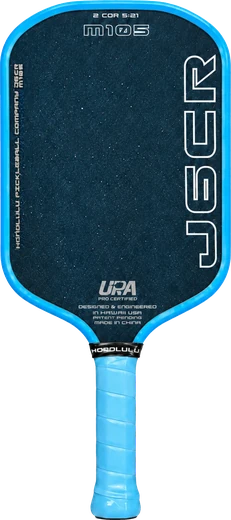
- 1Honolulu J6CR Crystal Blue2,424
- 2Selkirk Boomstik ST Elongated2,4195 RPM behind
- 3Honolulu J6CR M 105 Crystal Blue2,40519 RPM behind
- 43Luzz Cannon2,276148 RPM behind
The Perseus Pro IV is JOOLA's Gen 3 elongated from 2025, and it costs about $150 in 16mm. It's the obvious comparison, because the two are built almost exactly alike. Both have a polypropylene honeycomb core with an EVA foam insert and foam around the perimeter, and both have a raw carbon face.
On power, the Cannon lands right where the 16mm Pro IV does. Both scored 85 out of 100, right around the average elongated. Back in December 2025 I called it essentially a Pro IV with better spin, and on power and spin, that still holds up.
Spin is where the Cannon pulls away. It spins about like the average elongated, while the Pro IV is one of the lowest-spinning elongateds I've tested, and the Cannon gets about 150 RPM more on my serve test. You'll feel that on topspin drives and rolls.
The Pro IV is a little more forgiving and a little quicker in your hands. Its sweet spot is a bit bigger, which helps on mishits, and it's a bit lighter to swing, which helps when the ball comes fast at the kitchen. Pop is about the same on both, and both are under the average elongated. So the trade is pretty simple. With the Cannon, you lose a little of that forgiveness and hand speed, and in return you get a lot more spin at a lower price.
How it feels in your hand next to other elongateds you can buy
Heavier in your hands, and a little less steady when you miss the middle
How heavy the paddle feels when you swing it. Lower means faster hands.
Swings heavier than most elongated paddles.
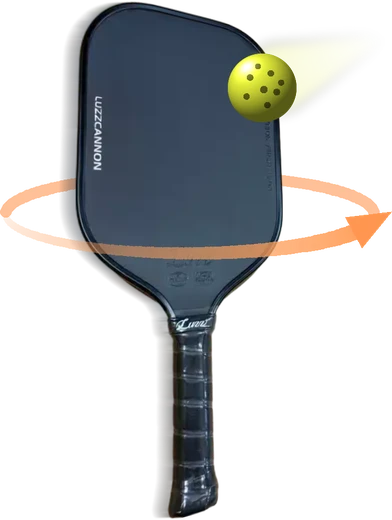
How well the paddle resists turning in your hand when you hit off center. Higher means steadier.
Less steady than most elongated paddles.
How its sweet spot stacks up against other elongateds you can buy
A smaller sweet spot than most elongated paddles
Both rings are sized to their score.
The catch: it isn't very forgiving
Its sweet spot is in the bottom quarter of elongateds, and nearly every paddle under $100 has a bigger one. Control is lower than on most elongateds too, so resetting a hard ball at your feet or dropping one into the kitchen takes more of your own touch.
If your touch is already good, you can live with that. If you're still working on your drops, it'll show.
It also swings a bit heavy for an elongated, and only 12 elongateds swing heavier. You'll still find it quick enough at the kitchen, though in a fast hands battle you'll notice the extra weight.
That sweet spot score comes from my soft-shot drills, and it's a separate thing from twist weight, which is how steady the face stays when you block one off center. The Cannon's twist weight is about average, so you probably won't need lead tape.
What it feels like
It feels the way a Gen 3 paddle should. The ball comes off the face right away, and drives have a crisp, hollow crack. It isn't as stiff or as hollow as the Pro IV, though.
Feel has also varied from one Cannon to the next, some poppier and more hollow and some stiffer, so if yours doesn't feel like a friend's, that's not your imagination.
How long it lasts
Two things wear on a paddle like this, the face and the core. The face is raw carbon fiber with a peel-ply texture, and the spin comes from that rough surface grabbing the ball. That surface doesn't stay rough forever, and raw carbon faces have lost 14 to 20% of their spin in my testing. I haven't run a wear test on the Cannon itself, but there's no durable grit on it, so I'd expect the spin to fade the same way.
The core is the other thing to watch. When I ranked the Cannon in March 2026, I said I wasn't sure how long its polypropylene core would hold up. With that kind of honeycomb, the risk is core crush, where the honeycomb inside breaks down over time.
Luzz's own warranty covers manufacturing defects for a year on paddles bought from Luzz, and it takes returns for 30 days. For $30, Care+ stretches that to two years from purchase, and it also covers a face, core or edge guard that breaks down early, plus accidental damage with a possible deductible. Care+ doesn't say core crush by name, but it does cover a core that breaks down early, which is why I'd add it if you play a lot. Just know you can only add it at checkout.
What about the Cannon2 M1?
Luzz now sells two Cannons on the same page, the Cannon Original I'm reviewing here and the Cannon2 M1, which Luzz added in July 2026 at $119. Luzz calls the Cannon2 M1 the upgraded successor, and it names three changes. There's an Aero-9966 coating over the carbon face, stabilizing weights on both sides of the frame, and a reinforced core that Luzz says holds its stiffness longer. Those are Luzz's claims, and time will tell. I haven't scored the Cannon2 M1 yet, so I can't tell you how it plays next to this one.
There's also a $149 Cannon EX with a foam core, but Luzz lists it as not certified, so it's out for any sanctioned event.
What owners are saying
I read the Cannon's reviews on Luzz's own store and on Trustpilot in October and November 2026.
Luzz's store shows 769 reviews, nearly all of them five stars, but it only shows you the praise, like how much power and pop you get for the money, so it doesn't tell you much.
Trustpilot gives a more useful picture. Luzz has 91 reviews there, averaging close to five stars, and they cover all of its paddles and its service. Two Cannon owners said the edge guard started to come off, and Luzz offered each of them a replacement. Five other owners praised Luzz's warranty service, which is a good sign, but none of them said what had gone wrong, so there's no telling yet how Luzz handles a claim for a crushed core.
The MPP Turbo ArmorGrit Elongated beats it on paper
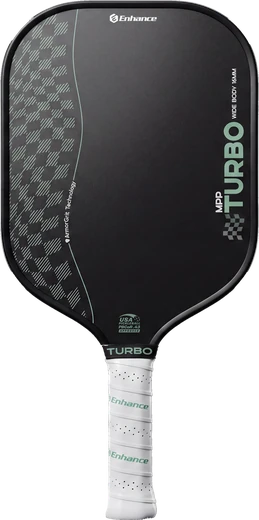
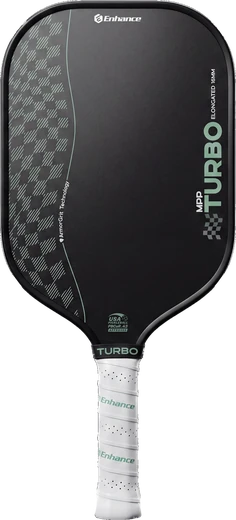
For most players, I'd pick this one over the Cannon. The Enhance MPP Turbo ArmorGrit Elongated is a power paddle with a full foam core, no honeycomb at all, and its face has ArmorGrit, a grit coating meant to last. The Cannon doesn't beat it on a single score. The Turbo hits a bit harder, pops and spins a good bit more, and its sweet spot and control are both a lot better. It swings lighter too, so it's quicker in your hands. And at $99.99 with code STSPICKLEBALL, it's only about two dollars more.
There are still three good reasons to pick the Cannon. The first is approval. The Turbo is approved by USA Pickleball only, so if you play events that require UPA-A, the Cannon is legal there and the Turbo isn't. The second is feel. If you love the crisp, hollow crack of a honeycomb core, the Cannon has one and the Turbo doesn't. The third is weight. The Cannon swings heavier, so if you like feeling some heft carry through the ball on drives, you get that here, though the Turbo still hits harder and is quicker in your hands.
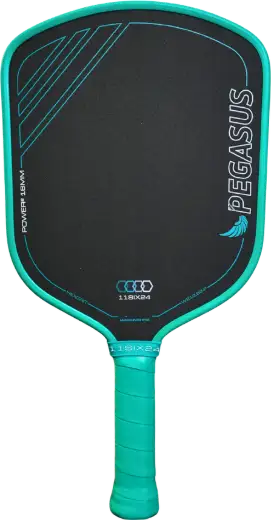
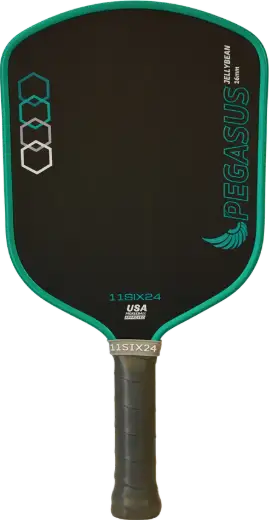
On grit, ArmorGrit has worn a little faster than 11SIX24's HexGrit and Honolulu's Crystal Blue grit so far, 20 to 25 games into my wear test. Time will tell how it holds up, but the Cannon has no durable grit at all.
Other paddles to look at
Two paddles you might pick instead
How it stacks up against the Glider 2026 and the Inferno2 M1
A paddle only wins a score when it leads by 5 points or more.
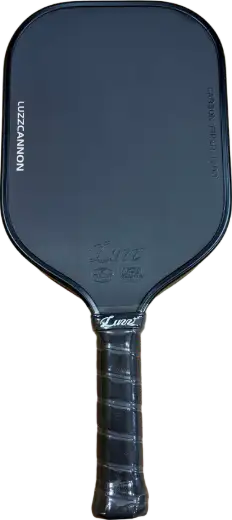 CannonElongated · $98.10
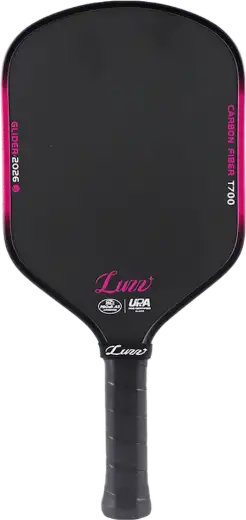 Glider 2026Hybrid · $107.10
The Cannon hits harder. The Glider 2026 spins more, has a bigger sweet spot and is more controllable. Pop is about the same. The Glider 2026 costs about $9 more.
CannonElongated · $98.10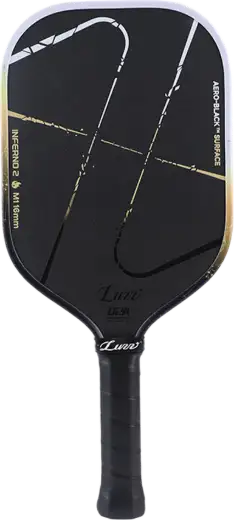 Inferno2 M1Elongated · $215.10
The Cannon is more controllable. The Inferno2 M1 hits harder, has more pop, spins more and has a bigger sweet spot. The Inferno2 M1 costs about $117 more.
Luzz Glider 2026: the same core in a lighter-swinging hybrid
The Glider 2026 is Luzz's hybrid from May 2026, with the same honeycomb core and foam as the Cannon plus Luzz's 984-Aero coating, which Luzz says works into the carbon weave. It's approved by USA Pickleball and UPA-A too, and it's one of the lightest-swinging hybrids I've tested. Next to the Cannon, it's a lot more forgiving and a lot easier to control. Among hybrids, though, its sweet spot is only about average and it's a good bit under average on control. Spin is about the same as the Cannon's. Its power is a bit lower, you lose a little reach since it's 0.2 inches shorter, and its 5.31 inch handle is tight for a two-handed backhand. At $107 with code STSPICKLEBALL, it costs about $9 more than the Cannon, and it's the one I'd look at if you like this build but want something easier to play and don't mind a hybrid.
Luzz Inferno2 M1: the big step up
The Inferno2 M1 is Luzz's full foam power paddle from August 2026, with what Luzz calls its Aero-Black silicon carbide surface, and it's the hardest-hitting elongated I've tested. Against the Cannon, it spins and pops a good bit more, and the sweet spot is bigger too. It has a bit less control, and it swings about as heavy. The price is more than twice the Cannon's, at $215 with code STSPICKLEBALL. It's also approved by UPA-A only for now, so it can't be used in USA Pickleball sanctioned tournaments, though most local leagues and clubs accept it. Luzz says a version with both approvals is in production. It's the one to look at if you want the most power in an elongated and you don't play USA Pickleball events.
My call
With the Cannon, you get the 16mm Pro IV's power with a lot more spin for less money, and it's the only paddle under $100 with real power and both approvals. I'd buy it if you need that UPA-A approval, or if your dinks and resets are already in good shape and you like a paddle that swings a bit heavy on drives.
On November 2, 2026, the Cannon was $109 at Luzz. Buy it from Luzz and code STSPICKLEBALL takes 10% off, which brings it to $98, and you can add Care+ at checkout. Buy it from a store and the warranty goes through that store.
For everyone else, I'd get the MPP Turbo ArmorGrit Elongated. It costs about the same, hits a bit harder and is a lot easier to control, and it's No. 1 on my under $100 list, where the Cannon sits tenth.
Testing details
- Tested
- July 28, 2026
- Power and pop
- 20 full serves for power and 20 punch volleys for pop, every ball speed read on a Stalker radar gun.
- Spin
- 20 more serves on the radar. I drop the outliers and average the rest, which gave this paddle 2,276 RPM.
- Swing and twist weight
- Measured on a Briffidi SW1 swing weight machine.
- Sweet spot and control
- The same dinks, drops, resets and drives off a Titan ONE ball machine, for every paddle.
- The scores
- Out of 100, with the same tests for every paddle. The top paddles I've tested score 100.
- Published
- Updated
- Scores from
- My database, updated November 21, 2026. How I test
 No. 1
 No. 2
 No. 3