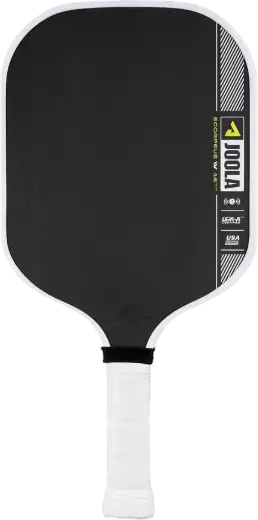
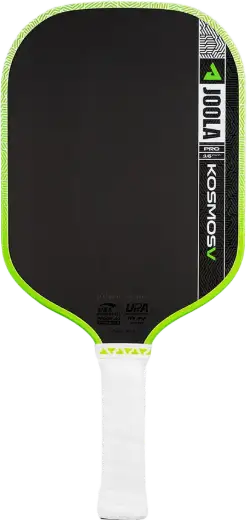
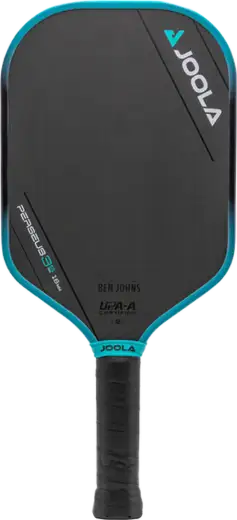
The JOOLA Perseus Pro IV is a Gen 3 elongated (thermoformed honeycomb with perimeter foam) in 14mm and 16mm. They play like two different paddles. The 14mm is a pop paddle for fast hands at the kitchen. The 16mm is a drive paddle, and no honeycomb elongated with perimeter foam I've tested hits harder. The catch: low control and some of the lowest spin I've measured, on both. So the Pro IV is for experienced players who already have a solid soft game and want as much pop or power as they can get. My pick is the 14mm, because its pop sits near the top of all the paddles I've tested. JOOLA has both thicknesses on sale for $149.95, down from $249.95. JOOLA doesn't take discount codes, so there's no code for this paddle. JOOLA provided both paddles, with no obligation to review them and no input on this review.
Every version, side by side
| Out of 100 | Perseus Pro IV 14mm$149.95 list price · elongated | Perseus Pro IV 16mm$149.95 list price · elongated |
|---|---|---|
| Power | 68B | 85ALeads by 17 |
| Pop | 93SLeads by 29 | 64C |
| Spin | 9F | 18FLeads by 9 |
| Sweet spot | 36D | 50CLeads by 14 |
| Control | 31F | 35D |
| Swing weightlower is quicker | 115.3 | 116.2 |
| Twist weighthigher is steadier | 6.07 | 6.28 |
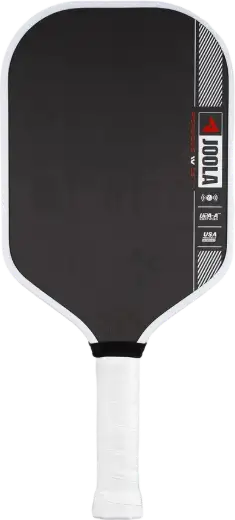
Perseus Pro IV 14mm
$149.95list price
JOOLA doesn't take discount codes, so there's no code for this paddle.
Perseus Pro IV 16mm
$149.95list price
JOOLA doesn't take discount codes, so there's no code for this paddle.
Pros and cons
Pros
- The 14mm has some of the most pop I've measured, and only eight paddles I've tested score higher.
- The 16mm drives the ball with a little more power than the typical elongated.
- The 14mm swings lighter than the typical elongated.
- Both thicknesses are on the USA Pickleball and UPA-A approved lists.
Cons
- Spin is some of the lowest I've measured on both thicknesses.
- Control is clearly below the typical elongated on both, so it's a tough paddle if you struggle with pop-ups.
- Core crush is a known problem on the Pro IV line.
- Cheaper foam paddles match or beat each thickness on my numbers.
Quick answers
Should I get the 14mm or the 16mm Perseus Pro IV?
Get the 14mm if you win your points at the kitchen line with speed-ups and counters. Get the 16mm if you win them with drives from the baseline, or if you miss the center a lot.
How is the Perseus Pro IV different from the Perseus 3S?
The Pro IV is a small refinement of the 3S. JOOLA's main change was adding foam in the throat, and the Pro IV now costs $50 less than the 3S's listed price.
Is the Perseus Pro IV the Ben Johns paddle?
Yes. JOOLA's product copy for the Pro IV names Ben Johns as the signature athlete. JOOLA has since replaced it with the Perseus Pro V, which feels softer and quieter.
Firm and crisp in both thicknesses, and harsher on the 14mm
Both thicknesses have a firm, crisp Gen 3 honeycomb feel. The 14mm is the stiffer of the two, and it's harsher than the 16mm, so it's going to suit players who like to feel every hit. The 16mm softens up a little once it's broken in.
The 16mm also holds the ball a beat longer than the 14mm does. It has a sharp crack and a hollow sound off the face, but it sounds more solid than the Perseus 3S 16mm.
The 14mm is quick in your hands for an elongated, and my swing weight numbers back that up. On short strokes at the net, the 14mm is really poppy, and the ball jumps right off the face.
Every so often the 16mm jumps hot off the face, and a ball you meant to keep in sails.
16mm for the baseline, 14mm for the net
How its spin stacks up against other elongateds you can buy
Less spin than most elongated paddles, 179 RPM below the average
The top three for spin
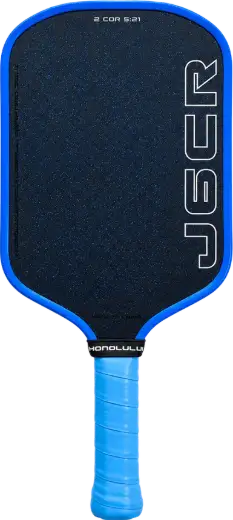
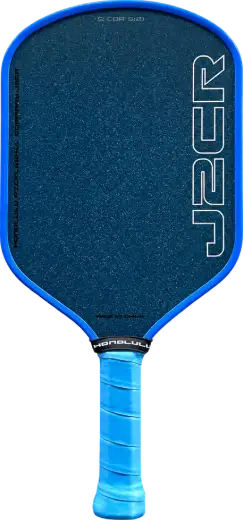
- 1Honolulu J6CR Crystal Blue2,424
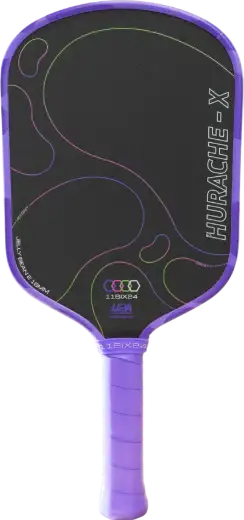
- 211SIX24 Hurache-X Jelly Bean 22,39529 RPM behind
- 3Engage Axiom Elongated2,39430 RPM behind
- 78JOOLA Perseus Pro IV2,083341 RPM behind
Drives, serves and spin
Drives and serves are the 16mm's thing. You get easy pace without a big swing. Only 18 elongated paddles I've tested have more power, and not one of them is honeycomb with perimeter foam. That's the thicker core. Thicker cores hit harder on full swings.
The 14mm is just okay on drives. You have to swing harder for pace, and its power is clearly below the typical elongated.
The two thicknesses spin about the same, and spin is low on both. Only five paddles I've tested spin less than the 14mm, and only 12 spin less than the 16mm. I also haven't tested a paddle with as much power as the 16mm that spins less. So if you shape your serves and drives with spin, the Pro IV is going to work against you.
Speed-ups, counters and put-aways
At the kitchen line, the 14mm is the one you want, because it's poppier than the 16mm and easier to be aggressive with on speed-ups and counters. It scored 93 out of 100 for pop, and only one honeycomb elongated with perimeter foam I've tested has more, the Perseus 3S 14mm. Here the thinner core has the extra pop, and pop plus a light swing makes the 14mm great in hands battles.
The 16mm isn't a hands paddle, though. Its pop is clearly below the typical elongated, so it doesn't give you much extra pace on short swings.
Both can put a ball away: the 16mm with power on a full swing, the 14mm with pop on a short, fast one.
Dinks and resets
Both thicknesses scored clearly lower for control than the typical elongated, and they're about the same as each other. So dinks and resets need a careful touch with either one. On the 16mm, the face gives pace back on resets, so you need a compact stroke, because a loose one sends the ball long or pops it up.
With either one, shorten up on resets and loosen your grip to take pace off. If resets are already your weak spot, look at the more controllable paddles below.
Off-center hits
Twist weight is how well the face holds steady in your hand on an off-center hit, and the 16mm's twist weight is above the typical elongated's. So the 16mm is the steadier of the two on mishits, and it's forgiving for an elongated power paddle. Its sweet spot is about the same as the typical elongated's, so it isn't oversized.
The 14mm goes the other way. Its twist weight is below the typical elongated's, and its sweet spot is clearly smaller. Only 15 elongated paddles I've tested score lower for sweet spot. Thinner 14mm paddles tend to play their best with some added weight, so if you get the 14mm, try lead tape at 3 and 9 o'clock. That raises the twist weight, but it also adds swing weight, so you give up a little hand speed.
How it feels in your hand next to other elongateds you can buy
Quick in your hands, a little less steady when you miss the middle
How heavy the paddle feels when you swing it. A lower number swings quicker.
Swings lighter than most elongated paddles.
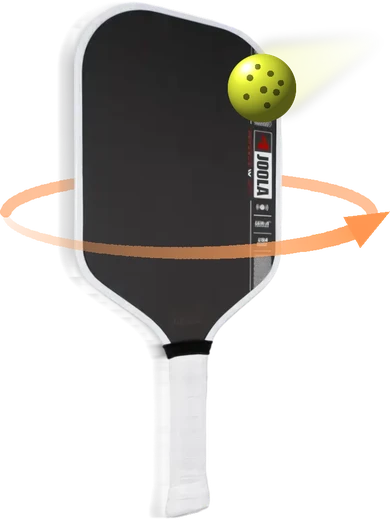
How much the paddle fights twisting when you miss the middle. A higher number is steadier.
Less steady than most elongated paddles.
How its sweet spot stacks up against other elongateds you can buy
A smaller sweet spot than most elongated paddles
Both rings are sized to their score.
Same price and shape, so pick by where you win your points
Same price, same 16.5 by 7.5 inch shape, and a 5.5 inch handle with room for a two-handed backhand.
The 14mm is for kitchen-line players who want pop and fast hands. It has far more pop than the 16mm, and it swings slightly lighter. In exchange, it has clearly less power and a clearly smaller sweet spot.
The 16mm is for players who drive from the baseline and want the bigger sweet spot. It has clearly more power and a clearly bigger sweet spot than the 14mm. What it costs you is pop, because the 16mm has far less of it.
The grip is 4.125 inches on the 14mm and 4.25 inches on the 16mm. The 14mm weighs 7.7 to 8.1 ounces, and the 16mm weighs 7.9 to 8.3 ounces.
If you can't decide, take the 14mm. Its pop is the one real standout on this paddle, and it's also the harder thickness to replace for less money. Only one cheaper elongated matches the 14mm on both pop and power, which is the Vatic Pro V-Sol Pro V7, whereas seven cheaper elongated paddles match the 16mm.
Next to similar honeycomb builds, it gives up control and spin
I tested both thicknesses on May 12, 2026. The core is polypropylene honeycomb with an EVA foam insert and perimeter foam, and the face is raw carbon with a raw peel-ply surface. JOOLA says the foam it added in the throat is there for balance, feel and forgiveness, and it wasn't meant to add power. The guys over at JOOLA also say that throat foam raises twist weight, but my numbers don't back that up, because both Pro IV thicknesses have a lower twist weight than the Perseus 3S of the same thickness.
Next to the typical honeycomb elongated with perimeter foam, the 14mm's power is about the same, and it has far more pop. Its sweet spot is clearly smaller, though, and it has far less control and far less spin. Next to 16mm paddles with that same build, the 16mm has clearly more power and about the same pop, and its sweet spot is a little smaller. Control is clearly lower on the 16mm, and spin is far lower.
JOOLA's warranty runs 12 months when you register the paddle through the handle's NFC chip.
Owners love the feel, but core crush keeps coming up
JOOLA released the Perseus Pro IV on March 4, 2025, so it's been out for about a year and a half.
Owners praise the feel most. Several say they play their best with it and keep going back to it, and when they name a thickness, it's the 16mm. A couple like how easy the power comes.
The most common complaint was the price back when it was $249.95, with owners saying it was overpriced for what it is, and some saying they don't trust JOOLA. A couple of owners also say it plays almost the same as the Perseus 3S.
Durability comes up a lot with the Pro IV, and core crush is the only problem owners report. Over time the honeycomb inside breaks down, and the paddle plays hotter, like a trampoline. It's mostly a manufacturing thing. Full foam has no honeycomb to crush, so it holds up better.
As of October 2026, I found core crush reports on the Pro IV from July 2025 to May 2026. Two of them name the 16mm. None name the 14mm.
That's a small number of reports, so it tells you core crush is a real risk on the Pro IV, but it can't tell you how often it happens. At launch in March 2025, the guys over at JOOLA said they'd added quality control, core and mold checks, and more destructive testing to fight core crush. JOOLA hasn't announced a fix since, as far as I've seen. Some owners went through up to three replacements in the 12 month warranty, and a couple had slow replacements or trouble with the NFC registration.
Should you buy the Perseus 3S or the Pro IV?
The Perseus 3S is the previous Perseus, and of the paddles I've tested, it's the other model that comes up most when people shop for a Pro IV. It costs more now, at $199.95. The two share the same core spec, raw carbon face, shape and 5.5 inch handle. Besides the throat foam, the difference is that the Pro IV is on both the USA Pickleball and UPA-A lists, whereas the 3S is only on the UPA-A list.
In the 14mm, the two are close. The Pro IV 14mm has a little less power than the 3S 14mm, with about the same pop and control, and its sweet spot is clearly smaller. The 3S 14mm also spins more.
The 16mm is where they really split. The Pro IV 16mm has clearly more power than the 3S 16mm but far less pop, and its sweet spot is a little smaller. Control is the same, and the 3S 16mm spins more here too. Both Pro IV thicknesses also swing a little lighter than the 3S.
If you liked the 3S, the Pro IV gives you the same family feel for less money. But if the pop was what you loved about the 3S 16mm, the Pro IV 16mm isn't going to give you that, because it trades that pop for power.
Two $99.99 foam paddles match or beat each thickness
Two paddles you might pick instead
How it stacks up against the V-Sol Pro V7 and the MPP Turbo ArmorGrit Elongated
A paddle only wins a score when it leads by 5 points or more.
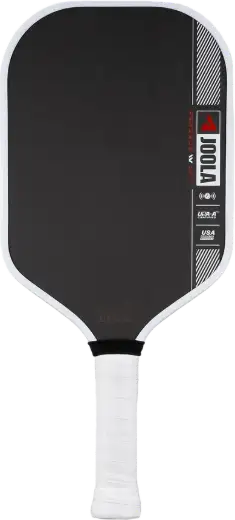 Perseus Pro IVElongated · $149.95
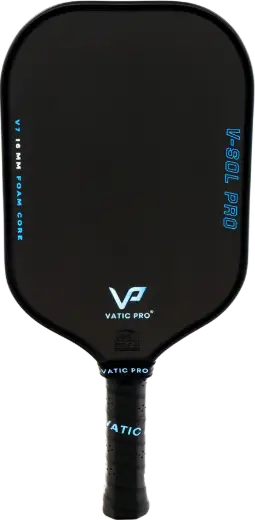 V-Sol Pro V7Elongated · $99.99
The V-Sol Pro V7 spins more, has a bigger sweet spot and is more controllable. Power and pop are about the same. The V-Sol Pro V7 costs about $49 less.
Perseus Pro IVElongated · $149.95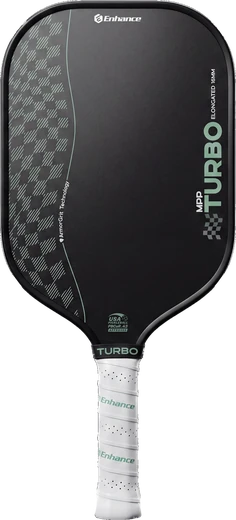 MPP Turbo ArmorGrit ElongatedElongated · $99.99
The Perseus Pro IV has more pop. The MPP Turbo ArmorGrit hits harder, spins more, has a bigger sweet spot and is more controllable. The MPP Turbo ArmorGrit costs about $49 less.
The Vatic Pro V-Sol Pro V7 is the one for 14mm shoppers, and the Enhance MPP Turbo ArmorGrit Elongated is the one for 16mm shoppers.
Vatic Pro V-Sol Pro V7
The V7 is $109.99, or $99.99 with the code STSPICKLEBALL, so it's $39.96 less than the Pro IV before the V7's code. It's for hands players who want the 14mm's pop without its weak spots. Same pop and power as the 14mm, with far more spin, control and sweet spot. It's only on the USA Pickleball list, not UPA-A, and the 5.3 inch handle is tight for two hands. It's 16mm full foam, not 14mm honeycomb, and swings a little heavier. One year warranty.
Enhance MPP Turbo ArmorGrit Elongated
The MPP Turbo ArmorGrit Elongated is $119.99, or $99.99 with the code STSPICKLEBALL, which is $29.96 less than the Pro IV before the MPP Turbo's code. It does the 16mm's job better, because it beats the 16mm on all five of my scores, and it swings lighter too. Next to the 14mm, it has far more power, spin and control and a far bigger sweet spot, but clearly less pop. You do give up the UPA-A approval, though, and the warranty is one year on the core.
Honolulu J6CR Crystal Blue
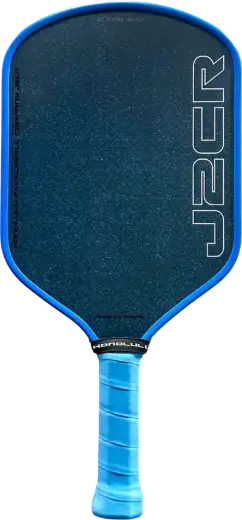
The J6CR Crystal Blue costs more, at $195.00, or $175.50 with the code STS10, which is $45.05 more than the Pro IV before the J6CR's code. It's the pick for spin-first players, because it has far more spin than either thickness. It also has a far bigger sweet spot and far more control than both. Next to the 16mm, it has about the same power and far more pop, and next to the 14mm, it has clearly more power and a little less pop. It swings lighter than both, and it's full foam. Keep in mind it's only on the UPA-A list, so it isn't USA Pickleball approved. The warranty is one year, and the handle is 6 inches.
Luzz Cannon
The Luzz Cannon is $109.00, or $98.10 with the code STSPICKLEBALL, which is $40.95 less than the Pro IV before the Cannon's code. It's for players who want the same Gen 3 build for less. It has the same core spec and face as the Pro IV, and it's on both the USA Pickleball and UPA-A lists. Next to the 16mm, it has the same power, about the same pop and control, and far more spin. Its sweet spot is a little smaller, though, and it swings heavier. The warranty's one year. Since it's the same honeycomb build, core crush is a risk on the Cannon too.
Get the 14mm if your hands win you points
Win points with speed-ups and counters, already have a solid soft game, and want a firm Gen 3 paddle legal under both USA Pickleball and UPA-A? Get the 14mm. Don't care about the honeycomb feel or UPA-A? The V7 and the MPP Turbo ArmorGrit Elongated do the same jobs for less.
Testing details
- Tested, Perseus Pro IV 14mm
- May 12, 2026
- Tested, Perseus Pro IV 16mm
- May 12, 2026
- Power and pop
- 20 full serves for power and 20 punch volleys for pop, every ball speed read on a Stalker radar gun.
- Spin
- 20 more serves on the radar. I drop the outliers and average the rest.
- Swing and twist weight
- Measured on a Briffidi SW1 swing weight machine.
- Sweet spot and control
- The same dinks, drops, resets and drives off a Titan ONE ball machine, for every paddle.
- The scores
- Out of 100, with the same tests for every paddle. The top paddles I've tested score 100.
- Published
- Scores from
- My database, updated October 15, 2026. How I test
 No. 1
 No. 2
 No. 3
 No. 4
 No. 3
 No. 4