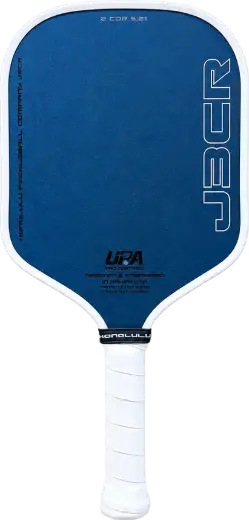
The J2NFK is Honolulu's J2NF hybrid with a Kevlar face instead of carbon, and it has more control than any other all-foam hybrid I've tested. It's the hybrid I'd hand a player who keeps the ball low with resets, blocks and dinks, and it still hits like an average hybrid on drives and serves. That's rare, since a paddle with this much control usually gives up power. The only hybrids with more control are three older Honolulus built on honeycomb cores instead of all foam, and none of them hit as hard. That mix of control and pace is also why it's No. 5 on my beginners list.
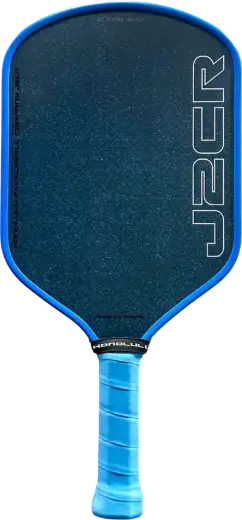
The catch is pop, which is how fast the ball jumps off the face on short punches and counters. The J2NFK is a little short on it for a hybrid, so when a ball sits up at the kitchen, you have to put a real swing on it to finish. If you'd rather finish points with pop at the kitchen, look at Honolulu's 2026 J2CR Crystal Blue. It's the same hybrid shape with Honolulu's Crystal Blue grit, and it has a lot more pop and spin for about the same money, but USA Pickleball hasn't approved it. The J2NFK has that approval, so it's good for any USA Pickleball sanctioned event. It's $175 with code STSPICKLEBALL, which takes $20 off Honolulu's Kevlar paddles.
Pros and cons
Pros
- Resets and blocks are easy to keep low, and only three hybrids score higher for control.
- It has the power of an average hybrid, and no other paddle with this much control hits as hard.
- It stays steady when you miss the center, more than most hybrids do.
Cons
- Short on pop for a hybrid, so if you win points with put-aways at the kitchen, you'll need a fuller swing to finish them.
Quick answers
Is the J2NFK good for beginners?
Yes. I have it fifth on my beginners list, because it gives a beginner more control than almost any hybrid and still some pace on drives. But if you miss the center a lot, look at the paddle one spot above it on that list, Enhance's MPP Turbo ArmorGrit Widebody. It's a 2026 foam widebody, and it forgives more of those mishits for $75 less.
Should I get the J2NFK or the J2NF?
The face is the main difference, so it mostly comes down to control or pop. Get the J2NFK if control comes first. Get the carbon J2NF if you'd rather have a little more pop and a swing that's a bit lighter. If you need a 6 inch handle, only the J2NF has one, and I cover what that version gives up below. With code STS10 the J2NF is $176, so the price is a wash.
Is the J2NFK USA Pickleball approved?
Yes. USA Pickleball added it to its approved list in June 2025, so you can play it in USA Pickleball sanctioned tournaments. It isn't on the UPA-A list, which is the approval PPA and MLP pro events use. Most local leagues and clubs accept either one.
Is the J2NFK still worth it now that Honolulu's CR line is out?
If control comes first, yes. The CR line is Honolulu's follow-up to the NF line this paddle comes from. Back in November 2025, I said the CR series is "definitely going to be a better pick" than the NF series. Both J2CR hybrids, the raw carbon one and the Crystal Blue, do have more pop for the same money. But the J2NFK has more control than every J2CR, so if that's what you're shopping for, this one still wins.
How I tested
How its spin stacks up against other hybrids you can buy
About average spin for a hybrid, 11 RPM above the average
The top three for spin
- 1Honolulu J2CR Long Handle Crystal Blue2,467
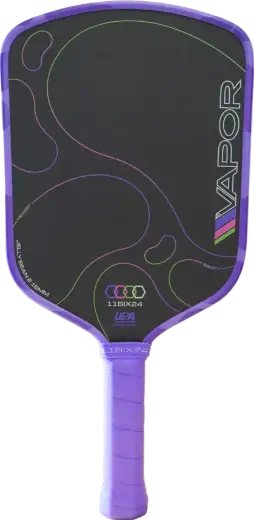
- 211SIX24 Vapor Jelly Bean 22,40364 RPM behind
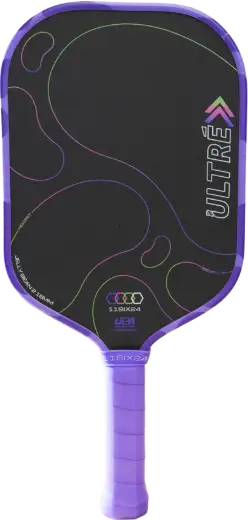
- 311SIX24 Ultré Jelly Bean 22,39770 RPM behind
- 27Honolulu J2NFK2,283184 RPM behind
I had the J2NFK before Honolulu launched it. In my launch video on June 9, 2025, I reviewed it next to the carbon J2NF and the J2FC+, another of Honolulu's all-foam J2s, and by that August I'd played countless games on the Kevlar and its sister paddles over four and a half months. With a Kevlar face, the question is how much control it adds and what that costs you, so control and pop are the numbers to watch here. Power and pop come from ball speeds on my Stalker Pro 3S radar, and the same radar reads spin in RPM when I serve. My Briffidi SW1 measures swing weight, or how heavy the paddle feels moving through the air, and twist weight, or how hard the face fights turning on a mishit. Control and sweet spot are my own scores, from the same ball machine reset, drop and dink drills every paddle goes through. All the numbers here are from my own testing.
J2NFK or J2NF: Kevlar or carbon?
The first question I'd ask about this paddle is whether to get it or the carbon J2NF, and it's simpler than the names make it look. Under the face, the J2NFK and the J2NF are the same paddle, with the same J2 hybrid shape and the same all-foam core, which Honolulu builds with an EPP foam center and EVA foam around the edge. Only the face changes. The J2NF has a carbon, fiberglass and carbon face, and the J2NFK has a Kevlar face that Honolulu calls its "control weave," which turns out to be a fair name. On my numbers, the two tie on power, spin and sweet spot, and the Kevlar version wins on control and stability. What it costs you is a bit of pop and a bit more weight in the swing.
My own taste went the other way. When I had them all in summer 2025, I played the J2NFK a decent amount, but most of the time I kept reaching for the J2NF and the J2NFT, a third version with a carbon and PET face Honolulu calls titanium. The J2NFT isn't in my test numbers, so I've left it out of the comparisons here. That's taste, though, and your game should decide this one. If you mostly reset and block, take the J2NFK. If you like to counter and speed the ball up at the net, the J2NF fits you better. It also comes with a 6 inch handle option that the J2NFK doesn't have, though that long handle version has less control than the J2NFK and is less stable than most hybrids.
Control and the soft game
It scored 87 out of 100 for control, a good bit above the average hybrid's 71, so when someone drives one at you, you can take the pace off and drop it back into the kitchen. On resets and blocks, the ball comes off the face very predictably, and it's the control pick of the NF line I've tested.
It's also very stable on off center hits, with twist weight in the top quarter of hybrids, so a block you catch away from the middle doesn't knock the face around much. The sweet spot is a bit bigger than the average hybrid's too, and if you want even more forgiveness, a gram or two of lead tape on each side makes it feel bigger.
Power, pop and spin
Drives and serves from the baseline come off with real pace, right in line with the average hybrid. Pop is a different story, though. It's in the bottom quarter of hybrids, and since pop is harder to control than power, giving some of it up is part of how the J2NFK gets all that control. On a short punch volley or a quick counter, the ball comes off a little slower than you'd expect. If you're a patient player who wins with soft hands, you'll barely notice. If most of your points come from fast exchanges at the kitchen, you will.
Spin is about average for a hybrid. If spin is high on your list, the J2CR Crystal Blue below spins a lot more.
How it feels in your hand next to other hybrids you can buy
About average in your hands, steadier than most when you miss the middle
How heavy the paddle feels when you swing it. Lower means faster hands.
About average swing weight for a hybrid.

How well the paddle resists turning in your hand when you hit off center. Higher means steadier.
Only six hybrids you can buy are steadier.
How its sweet spot stacks up against other hybrids you can buy
Only eight hybrids you can buy have a bigger sweet spot
Both rings are sized to their score.
Feel and swing
The face feels denser and more muted than the carbon J2NF's, and on blocks and resets it soaks up pace instead of springing the ball back at your opponent. For me, though, after months of games the Kevlar felt a little too rigid off the face, so keep that in mind if plush is what you're after.
It swings about like the average hybrid, so hand speed at the net is fine. It does swing a bit heavier than the carbon J2NF, though, so if quick hands are your whole game, the J2NF will feel faster at the net.
Handle, warranty and stock
Honolulu sells it as the Sword & Shield J2NFK. The handle is 5.5 inches, which leaves room for a two-handed backhand, and that's the only length it comes in. Honolulu covers it with a 1 year warranty against manufacturing defects on paddles bought from its own site, and paddles bought from another store go back through that store. If you buy from Honolulu, you can return it unused within 30 days. When I checked on November 3, 2026, Honolulu's store listed both colors, red and blue, as available, and Pickleball Nation had both colors in stock too.
What owners are saying
Owners love the control. When I read the reviews on November 3, 2026, there were eight on Desert Paddles and three on Pickleball Nation, and every one was five stars except a single four star review. Six owners praised the same thing, touch and control with enough power, like one Desert Paddles owner who called it a "great paddle with a lot of control." On the other side, one owner said the Kevlar picks up dust, and one found the 5.5 inch handle short.
Alternatives worth a look
Two paddles you might pick instead
How it stacks up against the J2CR Crystal Blue and the MPP Turbo ArmorGrit Widebody
A paddle only wins a score when it leads by 5 points or more.
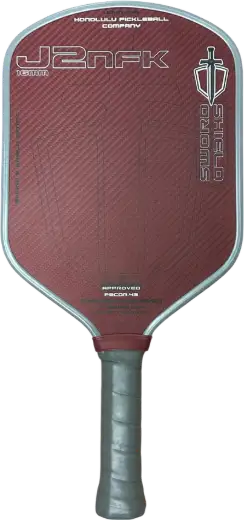 J2NFKHybrid · $175.00
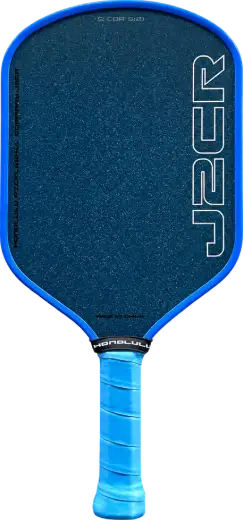 J2CR Crystal BlueHybrid · $175.50
The J2NFK is more controllable. The J2CR has more pop, spins more and has a bigger sweet spot. Power is about the same. Same price.
J2NFKHybrid · $175.00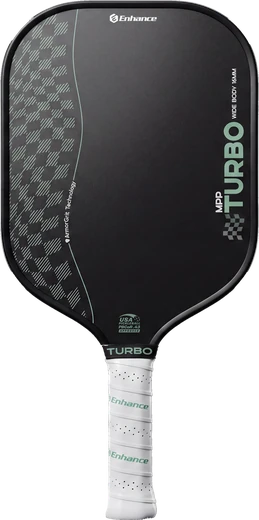 MPP Turbo ArmorGrit WidebodyWidebody · $99.99
The J2NFK is more controllable. The MPP Turbo ArmorGrit hits harder, has more pop, spins more and has a bigger sweet spot. The MPP Turbo ArmorGrit costs about $75 less.
Honolulu J2CR Crystal Blue: more pop and spin for the same money
The J2CR Crystal Blue is Honolulu's 2026 take on the J2 shape, with a gritty Crystal Blue surface, and it's No. 1 on my hybrid list. Next to the J2NFK, the ball comes off a lot faster on punches and it spins a lot more, with power close to the J2NFK's. Over 75 games in my wear test, that grit kept all but about 1% of its spin. The cost is a good bit of control, and because the ball jumps off that face, resets take a lighter touch. Its sweet spot plays a bit bigger, but it's less stable than most hybrids, so off center blocks get pushed around more than they do on the J2NFK. It's approved by UPA-A, but not by USA Pickleball, so it isn't allowed in USA Pickleball sanctioned tournaments. If you need USA Pickleball approval, the raw carbon J2CR is the approved version, with more power and pop than the J2NFK and less control. Both are $176 with code STS10, and Honolulu listed both as available on November 3, 2026.
Enhance MPP Turbo ArmorGrit Widebody: a bigger sweet spot for $75 less
The MPP Turbo ArmorGrit Widebody is Enhance's foam widebody, with a soft MPP foam core and Enhance's ArmorGrit coating on the face, and it's $99.99 with code STSPICKLEBALL. It sits one spot above the J2NFK on my beginners list, because its sweet spot is one of the biggest I've tested and it costs a lot less. You give up a good bit of control, though, and its 5.3 inch handle is short for a two-handed backhand. In return, you get a lot more pop and more spin, plus a bit more power in a lighter swing. MPP cores usually feel softer and more plush than EPP cores like the J2NFK's. So far, ArmorGrit is wearing a little faster than Crystal Blue in my wear test, about 20 to 25 games in. USA Pickleball approved it in September 2026, and Enhance's store showed the widebody available on November 3, 2026.
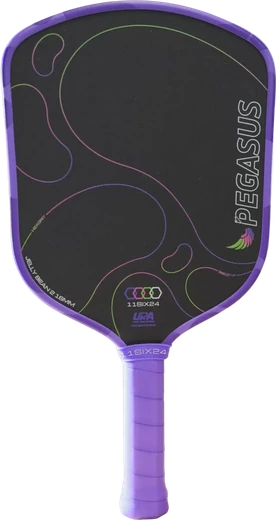
11SIX24 Vapor Jelly Bean: about the same control for $85 less
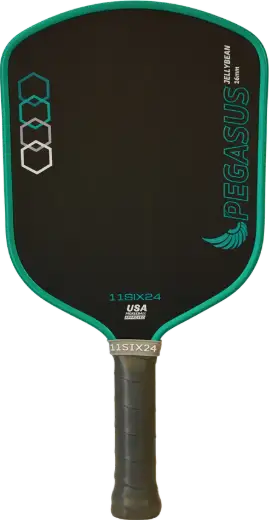
The original Vapor Jelly Bean is 11SIX24's 2025 control hybrid on an older polypropylene honeycomb core, and it's $90 with code STSPICKLEBALL. Its control is about the same as the J2NFK's, so on a tight budget, this is where I'd start. It hits with a good bit less power than the J2NFK, though, so your drives won't come off with the same pace. Its 5.75 inch handle gives a two-handed backhand a little more room. It's on USA Pickleball's approved list too, and 11SIX24 had every color in stock on November 3, 2026. Just don't mix it up with the newer Vapor Jelly Bean 2.
My call
This is a paddle for the player who wins at the kitchen with soft resets, blocks and dinks but still wants to hit a real drive. If that's you, I'd get it. It has more control than any other all-foam hybrid I've tested, it stays steady on off center hits, and it's $175 with code STSPICKLEBALL. Where I'd send you instead depends on what you're missing. For quicker counters, the carbon J2NF gives you a bit more pop and a bit lighter swing at the same price. If pop and spin matter more to you and your events take UPA-A paddles, get the J2CR Crystal Blue. If mishits are your problem, the Enhance MPP Turbo ArmorGrit Widebody is the more forgiving pick, and it costs $75 less. And on a tight budget, the Vapor Jelly Bean nearly matches its control for $85 less, though it hits softer.
Testing details
- Tested
- August 7, 2026
- Power and pop
- 20 full serves for power and 20 punch volleys for pop, every ball speed read on a Stalker radar gun.
- Spin
- 20 more serves on the radar. I drop the outliers and average the rest, which gave this paddle 2,283 RPM.
- Swing and twist weight
- Measured on a Briffidi SW1 swing weight machine.
- Sweet spot and control
- The same dinks, drops, resets and drives off a Titan ONE ball machine, for every paddle.
- The scores
- Out of 100, with the same tests for every paddle. The top paddles I've tested score 100.
- Published
- Updated
- Scores from
- My database, updated November 10, 2026. How I test
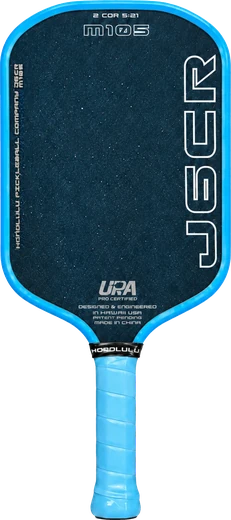
 No. 1
 No. 2
 No. 3