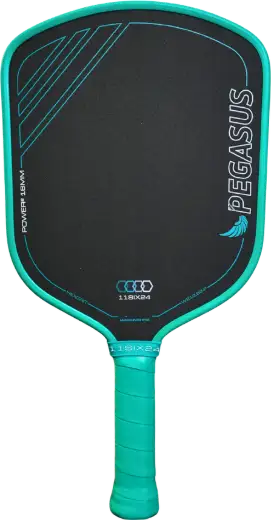
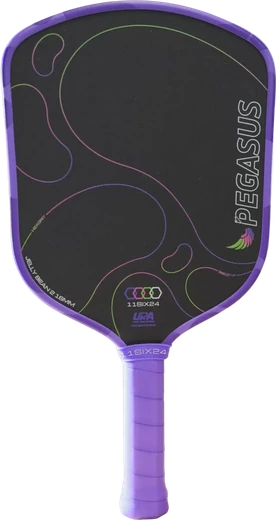
The Pegasus Jelly Bean is 11SIX24's original Jelly Bean widebody, and no paddle under $100 that I've tested has more control. That's why it's the first paddle I'd hand a beginner, or anyone whose shots keep popping up or sailing long. The ball stays low and goes where you aim it, and the sweet spot is one of the biggest I've tested, so your mishits still land in the court. It's $90 with code STSPICKLEBALL.
The catch is that it's a soft-hitting paddle, so the pace comes from you. Spin is about average for a widebody, and since the face is raw carbon, that spin fades as the face wears smooth. 11SIX24 still sells it right next to the newer Jelly Bean 2 from August 2026. That one has a grit built into the face that holds its spin, so if the fading spin is what bothers you, it's worth the extra money, unless you play in USA Pickleball tournaments, where it isn't approved.
Pros and cons
Pros
- Control that's hard to beat at any price, for $90 with code.
- Off-center hits still land, so beginners stay in points they'd otherwise give away.
- You can react fast with it in hands battles at the kitchen.
Cons
- It hits a lot softer than the average widebody, so on drives and put-aways the pace comes from your swing.
- Pop is a lot below average too, so you get little free speed on short punches at the kitchen, and that hurts most if you win points on speed-ups and counters.
- The raw carbon face has no grit, so whatever spin you start with drops off as the carbon goes smooth.
Quick answers
Is the Pegasus Jelly Bean good for beginners?
Yes, it's my No. 1 paddle for beginners. When you're new, I think pop-ups and balls flying long cost you a lot more points than a lack of power does, and keeping the ball down and in is what this paddle does best.
What's the difference between the Pegasus Jelly Bean and the Jelly Bean 2?
The Jelly Bean 2 is the newer version. 11SIX24 rebuilt it with a full foam core, meaning foam all the way through with no honeycomb, and put HexGrit on the face, a grit built in so the spin lasts. That makes the Jelly Bean 2 the one to get for spin, and the original still the one to get for control. Just know that the Jelly Bean 2 isn't USA Pickleball approved, and this one is.
Is the Pegasus Jelly Bean USA Pickleball approved?
Yes. USA Pickleball added it to its approved list as the Pegasus Jelly Bean 16mm in January 2025, so it's legal in USA Pickleball sanctioned tournaments. It isn't on the UPA-A list, though. UPA-A is the approval the PPA and MLP pro tours go by, so you can't use it at their events.
Is it the same paddle as the Monarch Jelly Bean?
Yes, as far as I can tell. It's the shape 11SIX24 sold as the Monarch Jelly Bean in 2024, with the same size, handle and face, and the old Monarch Jelly Bean link on 11SIX24's site now takes you to this paddle. The Monarch also came in 14mm, though, and the Pegasus Jelly Bean only comes in 16mm, with a longer warranty.
How I tested
I've tested 254 paddles, and whenever I count paddles on this page, I'm only counting the 186 you can still buy. For a control paddle, the scores I lean on most are control and sweet spot, and I rate both from ball-machine drills at the kitchen. Power and pop come from my Stalker Pro 3S radar, which clocks the ball as it leaves the face. That same radar reads spin off my serve test in RPM, which is how many times the ball turns in a minute. My Briffidi SW1 measures two things: swing weight, how hefty a paddle feels through a full swing, and twist weight, how stable it stays on balls you catch off center.
Control and forgiveness
Control is the whole reason to buy this paddle. It scores 95 out of 100, a good bit above the average widebody, so the ball goes where you aim it. The low pop helps your soft game too. The ball doesn't jump off the face, so your drops and resets stay low instead of floating up. Then there's the sweet spot. Only four paddles have a bigger one, so a ball you catch toward the edge of the face still comes off close to where you meant it to, and for a beginner who misses the center a lot, that's a big deal.
How it feels in your hand next to other widebodies you can buy
About average in your hands, about average when you miss the middle
How heavy the paddle feels when you swing it. Lower means faster hands.
About average swing weight for a widebody.

How well the paddle resists turning in your hand when you hit off center. Higher means steadier.
About average twist weight for a widebody.
How its sweet spot stacks up against other widebodies you can buy
Only four widebodies you can buy have a bigger sweet spot
Both rings are sized to their score.
The catch is pace
Power is where you pay for all that control. Only four widebodies hit softer, so on serves and deep drives you need a full swing to get the ball moving, and putting a ball away takes real effort.
Pop works the same way. When a hands battle speeds up at the kitchen, this paddle gives you very little for free, so you're putting more into every counter yourself. If you win points with pace, or you're switching from a power paddle, you'll miss that. For a beginner I don't see it as a problem, because keeping the ball in the court wins you more points right now than extra pace you can't aim yet.
Spin and the raw carbon face
How its spin stacks up against other widebodies you can buy
About average spin for a widebody, 23 RPM below the average
The top three for spin
- 1Honolulu J3CR Crystal Blue2,436
- 211SIX24 Pegasus Jelly Bean 22,37561 RPM behind
- 3RPM Q2 Widebody2,36967 RPM behind
- 2911SIX24 Pegasus Jelly Bean2,250186 RPM behind
The face is raw carbon fiber, and the rough carbon grips the ball, which is where the spin comes from. When it's new, it spins right around the average for a widebody. So it's nothing special, but nothing's missing either.
Raw carbon doesn't stay rough, though. The more you play, the smoother it gets, and smoother carbon grabs the ball less. In my wear tests, raw carbon faces have dropped 14 to 20% of their spin, and there's nothing on this face to slow that down. The Jelly Bean 2 fixes that with HexGrit, which only lost about 1% over 75 games, and that's the biggest reason to think about spending more.
How it feels and moves
Off the face, it's soft and dense with a little give, but it doesn't feel mushy. If you're coming from a firm, crisp paddle, you'll notice that right away.
It's one of the most head-light widebodies I've tested, and it feels quick at the kitchen, even though its swing weight is about the same as the average widebody.
Original or Jelly Bean 2
When 11SIX24 rebuilt the Jelly Bean as a full foam paddle with HexGrit, it ended up a very different paddle on the court. The Jelly Bean 2 spins more than almost any widebody. Next to the original, it hits a lot harder and pops a good bit more, but it has a bit less control and swings heavier. The sweet spot is about the same size, so your mishits still land.
It's $160 with code. USA Pickleball hasn't approved it, so you can't play it in USA Pickleball sanctioned tournaments, but it does have UPA-A approval. That's what PPA and MLP pro events use, and most local leagues and clubs accept it too.
So if you play rec and league games and you want spin that lasts, the extra $70 for the Jelly Bean 2 is worth it. But if you're just starting out, your budget stops at $100, or you play USA Pickleball tournaments, stay with the original.
What owners are saying
Most of the owner reviews for this paddle are on 11SIX24's own site, and on November 3, 2026 I read both the Pegasus Jelly Bean reviews and the ones left under the Monarch Jelly Bean name. The Pegasus page shows hundreds of reviews, mostly five stars, but only about two dozen have text I could read, and some of those likely go back to the Monarch days.
The thing owners say most is that it's a great first paddle or a steal for the money, though one said they hadn't felt any difference from their $30 paddle. A handful say it's light and fast in their hands. Four owners praise the control, and one said there wasn't much. Power is where they split. One owner said it lacks power and pop and the ball just "dies," which matches my numbers, and 11SIX24 replied that it's their control line and pointed to their Power paddles instead. A couple of others were happy with the power, and one owner added weight to get "enough pop and power" out of it.
One owner saw ball marks on the face after four games, and another said the marks are hard to clean off. The only defect report I found was a handle that snapped in the first session, and it turned out that paddle was damaged in shipping, so 11SIX24 covered it under warranty.
Pegasus Jelly Bean or Pegasus Power
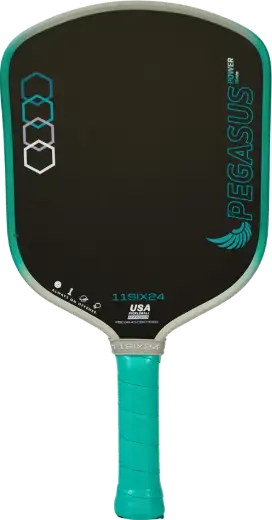
The Pegasus Power is the widebody 11SIX24 launched at $170 in early 2025. It's not the newer Pegasus Power 2, and today it costs the same as the Jelly Bean, $90 with code, which makes it 11SIX24's other widebody under $100. On paper it beats the Jelly Bean almost everywhere. You get a lot more power, a good bit more pop and more spin, so you don't have to make all the pace yourself, but its control drops a bit and it swings a bit heavier, so it doesn't move quite as fast at the kitchen. Its sweet spot is the biggest of any paddle under $100, too.
Both are USA Pickleball approved, and both have a raw carbon face, so neither one holds its spin the way HexGrit does.
If you want the biggest sweet spot you can get under $100 and more pace than the Jelly Bean gives you, I'd take the Pegasus Power and accept a bit less control. If the ball keeps popping up on you, or you're buying your first real paddle, the Jelly Bean's extra control is the better deal.
Other paddles to consider
Two paddles you might pick instead
How it stacks up against the Mach 2 Forza and the Harmony V
A paddle only wins a score when it leads by 5 points or more.
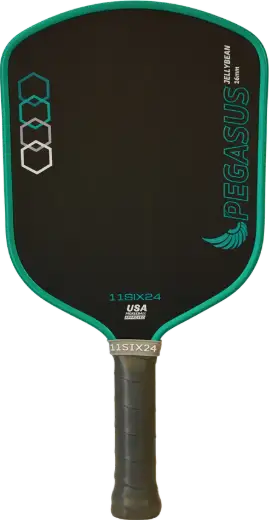 Pegasus Jelly BeanWidebody · $89.99
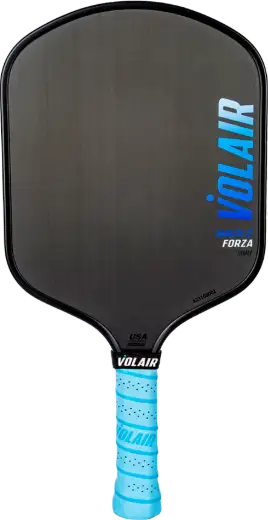 Mach 2 ForzaWidebody · $107.99
The Pegasus Jelly Bean hits harder, has a bigger sweet spot and is more controllable. The Mach 2 Forza has more pop. Spin is about the same. The Mach 2 Forza costs about $18 more.
Pegasus Jelly BeanWidebody · $89.99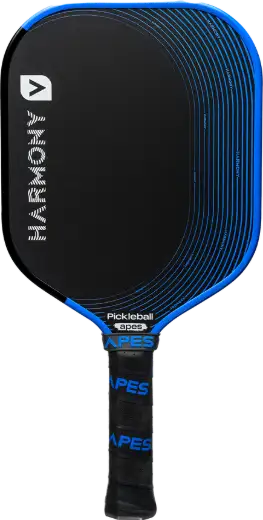 Harmony VWidebody · $71.99
The Pegasus Jelly Bean has more pop. The Harmony V hits harder. Spin, sweet spot and control are about the same. The Harmony V costs about $18 less.
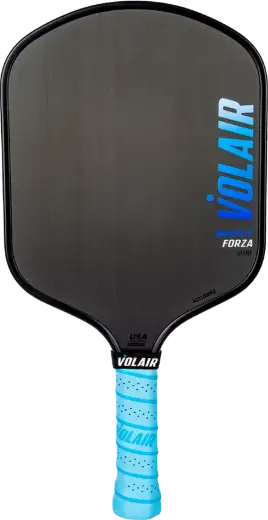
Volair Mach 2 Forza (16mm)
The Mach 2 Forza is Volair's control widebody, and the 16mm is the only paddle with more control than the Jelly Bean. You get a bit more pop and about the same power, spin and sweet spot, but it swings a bit heavier and costs $108 with code STSPICKLEBALL. It was my No. 1 control paddle of 2024, and it's still my top pick for control. As of November 3, 2026, the 16mm was only in stock in pink. The 14mm is a different paddle with a good bit less control, so make sure you're getting the 16mm.
Pickleball Apes Harmony V
The Harmony V is Pickleball Apes' budget widebody, and for $72 with code STSPICKLEBALL it's the cheaper way to get almost the same control and sweet spot. It hits a good bit harder, but its pop is a good bit lower, so you get even less help at the kitchen. It's also very stable on off-center blocks.
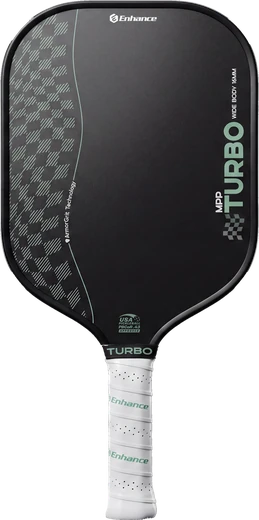
Enhance MPP Turbo ArmorGrit (widebody)
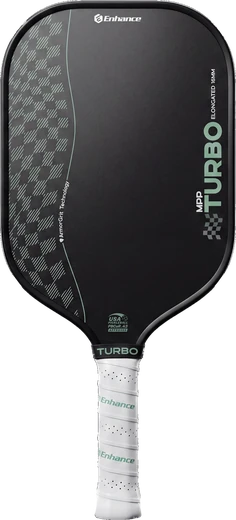
The MPP Turbo ArmorGrit is Enhance's full foam paddle with ArmorGrit, a coating Enhance designed to keep the spin from wearing off. I'm still running it through my wear test, and so far ArmorGrit is wearing down a bit quicker than HexGrit. Next to the Jelly Bean, the ArmorGrit widebody has a lot more power, pop and spin, with the same size sweet spot, so it's the one to look at if you want pace and spin for $99.99 with code STSPICKLEBALL. It's also USA Pickleball approved, which the Jelly Bean 2 isn't. The trade is a lot less control, and the 5.3 inch handle is tight for a two-handed backhand.
My call
For a beginner, or anyone who needs the ball to stay in the court before anything else, I'd buy the Pegasus Jelly Bean. With code STSPICKLEBALL it's $90, and all three colors were in stock at 11SIX24 on November 3, 2026. Just know going in that the pace is on you, and the raw carbon won't hold its spin forever.
The Pegasus Jelly Bean 2 is the upgrade if spin that lasts matters to you and you don't play USA Pickleball tournaments. It's $160 with code, and you give up a bit of control for it. If you'd rather have more pace for the same $90, the Pegasus Power gives you that and the biggest sweet spot under $100, for a little less control.
Testing details
- Tested
- June 11, 2026
- Power and pop
- 20 full serves for power and 20 punch volleys for pop, every ball speed read on a Stalker radar gun.
- Spin
- 20 more serves on the radar. I drop the outliers and average the rest, which gave this paddle 2,250 RPM.
- Swing and twist weight
- Measured on a Briffidi SW1 swing weight machine.
- Sweet spot and control
- The same dinks, drops, resets and drives off a Titan ONE ball machine, for every paddle.
- The scores
- Out of 100, with the same tests for every paddle. The top paddles I've tested score 100.
- Published
- Updated
- Scores from
- My database, updated November 8, 2026. How I test
 No. 4
 No. 4
 No. 1
 No. 2
 No. 4