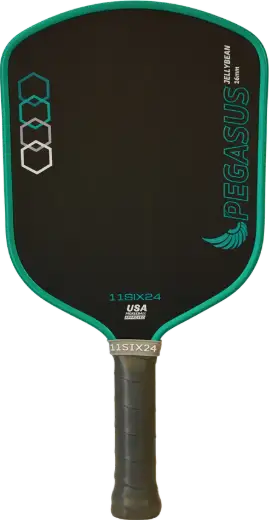
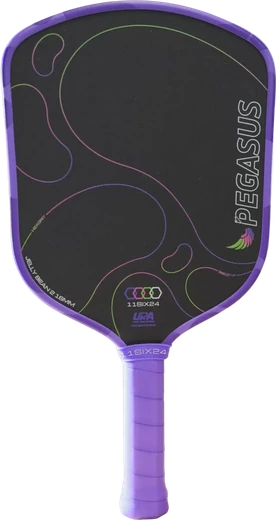
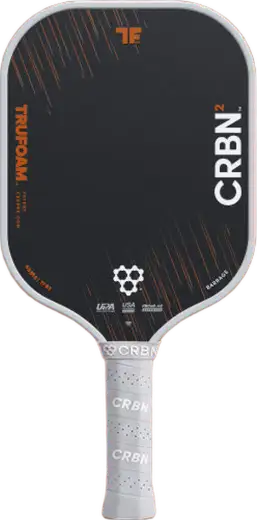
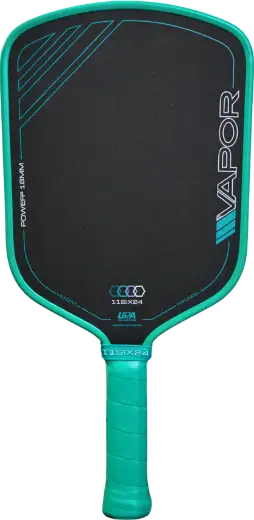
The Pegasus Power 2 is 11SIX24's power widebody, and it has the biggest sweet spot of any paddle I've tested. It's the widebody I'd buy if you want to attack without getting punished every time you miss the center, and it's No. 1 on my list for intermediate players. With a sweet spot that big, the blocks and drives you catch off center still come off clean. And it isn't a soft, slow widebody either, because it packs a lot more power than the average one and a good bit more spin.
Where you'll have to adjust is the pop. That's how fast the ball jumps off the face when you barely swing, like on a block or a punch volley, and only two widebodies have more. You get that same jump on a soft dink or reset, so if you rush one, it can sit up higher than you wanted. You'll also want to check approval before you buy. USA Pickleball hasn't approved the Pegasus Power 2, which rules it out for their sanctioned tournaments. It is approved by UPA-A, the standard the PPA and MLP pros play under, and most clubs and leagues accept that one too. It's usually $200 with code STSPICKLEBALL, but when I checked on November 7, 2026, 11SIX24 had it on sale for $160 through December 4.
Pros and cons
Pros
- The sweet spot covers so much of the face that a ball you catch near the edge still goes about where you meant it.
- Drives, serves and put-aways come off with a lot more power than you'd get from the average widebody.
- It spins a good bit more than the average widebody, and HexGrit, the grit 11SIX24 builds into the face, has barely lost any spin in my wear test.
- It's very stable on off-center hits, and it swings like an average widebody.
Cons
- It's one of the poppiest widebodies I've tested, so if your touch is still coming along, your dinks and resets will sit up more than you want.
Quick answers
Pegasus Power 2 or Boomstik Widebody?
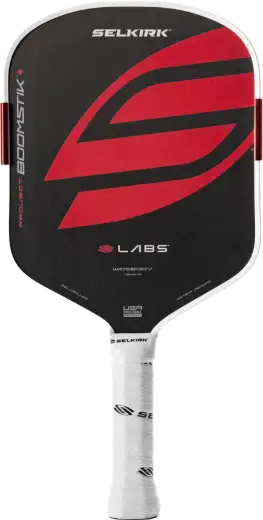
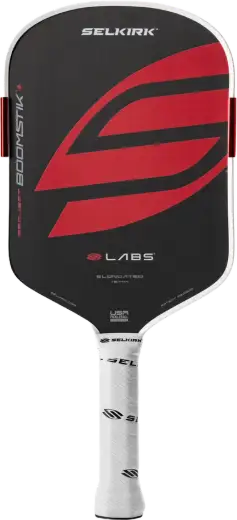
Selkirk's Boomstik Widebody is a big power widebody too, and it sits at No. 1 on my widebody list, one spot above the Pegasus. That isn't because it plays better. On my scores, the Pegasus hits a bit harder and spins more, and the rest is about even. I put the Boomstik first because it's approved by USA Pickleball, and no paddle you can take to their events has a bigger sweet spot. It also comes with a lifetime warranty, but it costs more. Its regular price is $333, and as of November 7, 2026, Selkirk had it on sale for $250 to $300 through November 22. If you play USA Pickleball events, get the Boomstik, and if you don't, the Pegasus gives you more paddle for less.
Can I take it to tournaments?
Not to USA Pickleball sanctioned ones. The Pegasus Power 2 has been on UPA-A's list since March 2026, so it's fine at events that go by UPA-A, and for a local event, it's worth checking with the organizer first. Don't hold out for a USA Pickleball version either. 11SIX24's founder said on a podcast in October 2026 that they had USA Pickleball Power 2s ready to go and decided against it.
Should I just get the original Pegasus Power?
The original Pegasus Power came out in 2025, and 11SIX24 still sells it, at $90 with code STSPICKLEBALL. It's USA Pickleball approved, its sweet spot is about as big as the Power 2's, and it has more control. It's on my control list as the biggest sweet spot you can get for under $100. But it hits a lot softer, it has a lot less pop, and it spins less. And with a plain raw carbon face, the spin it does have won't hold up the way HexGrit's does. So if you want an easy, forgiving paddle for USA Pickleball events and don't need the pace, the original is a great buy. If you want to attack, the Power 2 is a whole different paddle.
Is it good for a beginner?
It's not the paddle I'd start a beginner on. Back in May, I said the Pegasus was the only paddle in the Power 2 line I'd call great for a beginner. That was before 11SIX24 added the Ultré hybrid in June, and the Pegasus is still easily the most forgiving one in the line. But the pop makes dinks and resets harder to keep down, and those are the shots a beginner is still learning. My lists put it No. 1 for intermediates, not beginners. My No. 1 for beginners is the original Pegasus Jelly Bean from 2025, a widebody that's USA Pickleball approved and has a lot more control and a lot less pop than the Power 2.
How I tested
Sweet spot and control come from the same ball-machine dink, drop and reset drills every paddle gets. Power and pop are the ball speed my Stalker Pro 3S radar reads off the face, and spin is the RPM it picks up when I serve. I put every paddle on a Briffidi SW1 to get its swing weight, the heft you feel when you swing it, and its twist weight, which tells you how well the face holds square when you catch one off center. To see how a grit wears, I play games on the paddle, then retest the spin and check the face with my Starrett SR160 roughness tester. Every score is mine, my counts leave out paddles that are no longer sold, and the prices and stock on this page are what each store showed on November 7, 2026.
Where the sweet spot shows up
You feel the Pegasus's sweet spot most on the shots you don't hit perfectly. When someone speeds one up at you and you catch the block out near the edge, or you stretch for a drive, the ball still comes back with pace and lands in.
Part of that is the shape. Back in May, I put it next to Honolulu's J3CR widebody and said the Pegasus was just a better shape, one that "better utilizes surface area," and that it had a larger sweet spot. The face doesn't twist much when you miss the center either, since its twist weight is in the top quarter for a widebody. And for a paddle that stable, it doesn't feel slow, because its swing weight is right at the widebody average.
How it feels in your hand next to other widebodies you can buy
About average in your hands, steadier than most when you miss the middle
How heavy the paddle feels when you swing it. Lower means faster hands.
About average swing weight for a widebody.

How well the paddle resists turning in your hand when you hit off center. Higher means steadier.
Only five widebodies you can buy are steadier.
How its sweet spot stacks up against other widebodies you can buy
The biggest sweet spot of any widebody you can buy
Both rings are sized to their score.
Real power for a widebody
You don't usually pick a widebody for pace, but the Pegasus has plenty of it. Only three widebodies hit harder, so your drives and serves come through hard, and when you get a high ball at the kitchen, you can put it away. In that same May comparison, I said it had "a little bit more power and rigidity off the face" than the J3CR too.
The pop is the other half of it. When someone drives at you and you just get your paddle in front of it, the block comes back fast without much of a swing, and counters at the kitchen come off quick. That's a big reason it works for attacking players, and it's also what costs you on soft shots.
Spin that sticks around
How its spin stacks up against other widebodies you can buy
Only three widebodies you can buy spin more, 88 RPM above the average
The top three for spin
- 1Honolulu J3CR Crystal Blue2,436
- 211SIX24 Pegasus Jelly Bean 22,37561 RPM behind
- 3RPM Q2 Widebody2,36967 RPM behind
- 411SIX24 Pegasus Power 22,36175 RPM behind
Spin is the other big plus. It's what lets you swing hard on a drive and still have it dip in, or roll a dink so it kicks away low, and the Pegasus spins more than all but three widebodies.
The grit is what keeps it there. In July, when I was picking the top widebodies, I said "I absolutely love the Pegasus," and the first thing I pointed to was its HexGrit. That's what the original Pegasus Power is missing. Its face is plain raw carbon fiber, so its spin comes from the friction of the carbon's rough texture, and that texture wears down as you play. In my wear test, HexGrit gave up only about 1% of its spin over 75 games, while the raw carbon faces I've tested dropped 14 to 20%.
What all that pop costs you
On soft shots, the ball jumps off this face faster than it does off almost any other widebody. If you're used to a softer, plusher paddle and you get quick on a dink or a reset, it can float up. Its control is about average for a widebody on my drills, though, so the trouble is the pop catching you off guard, not a paddle that can't play soft.
If you'd rather skip that, look at the Pegasus Jelly Bean 2 below. It puts this same shape on a softer core, and it has a lot less pop. And if you already have decent touch, the pop is a big part of why the Power 2 is so much fun to attack with.
What owners are saying
I went through the owner reviews on the 11SIX24 store on November 7, 2026. The Pegasus Power 2 had 146, averaging 4.7 stars, and I read every review under five stars plus the 60 newest. Spin comes up the most. Close to 20 owners talked about the spin or how well the grit was holding up, and right behind that, 15 said they get all that power and still feel in control. One called it a "good balance of power and control," and another was "about 20 games in with no apparent spin loss."
The complaints that come up most are about the pop and the firm feel. Four owners said it was too poppy or too powerful, and one three-star review put it bluntly: "Everything is a pop up." A few more found it stiff or hard to control at first, though one said it got better as it broke in. The only grit complaints came from a couple of owners in April who felt it was thin or uneven, and nobody has said that since.
Durability is the thing you might worry about, because the elongated in this line, the Hurache-X Power 2, had 11 reports of a face coming loose or sounding dead and hollow, all packed into late March to mid-May 2026, and none after that. There have been some on the Pegasus too. I found four, spread out from April to November, and when the latest one came in, 11SIX24's founder answered it, saying they shipped a new paddle within a day without making the owner send the old one back. So it does happen now and then, but it's been a few scattered cases rather than a bad run, and a defect like that falls under the 12-month warranty. I wouldn't pass on the Pegasus over it.
Other paddles to look at
Two paddles you might pick instead
How it stacks up against the J3CR Crystal Blue and the MPP Turbo ArmorGrit Widebody
A paddle only wins a score when it leads by 5 points or more.
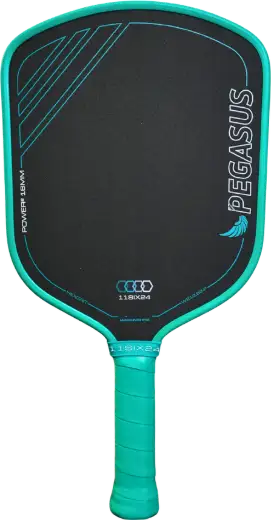 Pegasus Power 2Widebody · $199.99
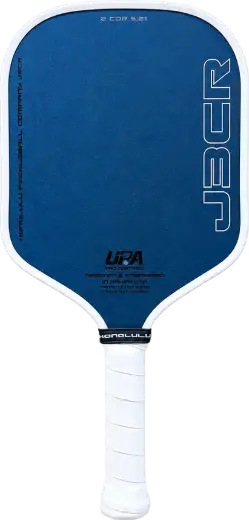 J3CR Crystal BlueWidebody · $175.50
The Pegasus Power 2 hits harder, has more pop and a bigger sweet spot. The J3CR spins more. Control is about the same. The J3CR costs about $24 less.
Pegasus Power 2Widebody · $199.99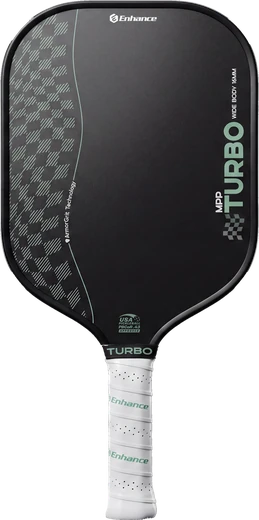 MPP Turbo ArmorGrit WidebodyWidebody · $99.99
The Pegasus Power 2 hits harder, has more pop and a bigger sweet spot. Spin and control are about the same. The MPP Turbo ArmorGrit costs about $100 less.
11SIX24 Pegasus Jelly Bean 2: the same shape with a good bit more control
The Pegasus Jelly Bean 2 is this same widebody shape on 11SIX24's softer Jelly Bean 2 foam core, still with HexGrit on the face. It gives you a good bit more control than the Power 2 and spins about the same, which makes it the easier paddle if you win your points with dinks, drops and resets. The cost is pace, since it hits a lot softer and the pop drops a lot. Its sweet spot is a bit smaller too, though still bigger than most widebodies'. Normally it's $160 with code STSPICKLEBALL, $40 less than the Power 2, but while the Power 2 sale runs, it doesn't save you anything. So right now, the reason to pick it is the lower pop and the extra control, not the price. It's UPA-A only too, and my widebody list has it as the big spin pick for control players.
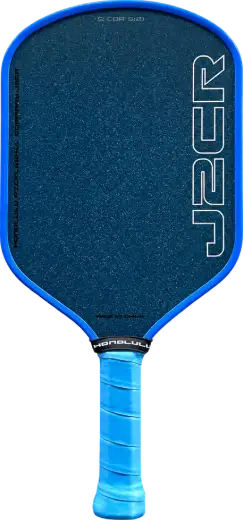
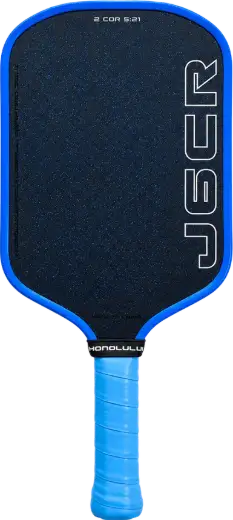
Honolulu J3CR Crystal Blue: more spin and a longer handle
Honolulu makes the J3CR Crystal Blue, a widebody that spins more than any other I've tested, and its Crystal Blue grit lasted as well as HexGrit in my wear test. It has about the same control as the Power 2, and the 6 inch handle leaves a little more room for two hands. But it gives up the two things I pointed to in May, the sweet spot and the power, and it's less stable on mishits too. So it's the widebody to get if spin and a longer handle matter more to you than forgiveness. It's $176 with code STS10 and UPA-A only. Honolulu's own store showed it sold out on November 7, 2026, so check back before you count on one.
Enhance MPP Turbo ArmorGrit Widebody: close on forgiveness, and USA Pickleball approved
Enhance's MPP Turbo ArmorGrit Widebody is a foam widebody with a raw carbon face, and ArmorGrit is the durable coating Enhance puts over that carbon. It costs $99.99 with code STSPICKLEBALL, about half what the Power 2 usually runs, and it's USA Pickleball approved. It swings a bit lighter and has about the same spin and control. You give up a bit of power, pop and sweet spot, though only four widebodies have a bigger sweet spot. The open question is the grit. ArmorGrit has only been through about 20 to 25 games of my wear test, and it's been wearing down a little quicker than HexGrit and Crystal Blue so far, so it isn't proven yet. Still, for USA Pickleball events on a budget, it's the widebody I'd look at first. No other paddle under $100 gives you this much forgiveness and spin together, and it hits a good bit harder than the original Pegasus Power.
My call
For widebody players who want a paddle that forgives them and still hits hard, the Pegasus Power 2 is my pick, because nothing I've tested has a bigger sweet spot, it hits a lot harder than most widebodies, and HexGrit keeps the spin around. The pop just takes some getting used to on soft shots. For USA Pickleball events, I'd go with the Boomstik Widebody, or the MPP Turbo ArmorGrit Widebody if you want to spend less. If soft shots are most of your game, get the Pegasus Jelly Bean 2, and if you're just starting out, get the original Pegasus Jelly Bean. The Power 2 is usually $200 with code STSPICKLEBALL, and it was $160 on sale when I checked.
Testing details
- Tested
- May 2, 2026
- Power and pop
- 20 full serves for power and 20 punch volleys for pop, every ball speed read on a Stalker radar gun.
- Spin
- 20 more serves on the radar. I drop the outliers and average the rest, which gave this paddle 2,361 RPM.
- Swing and twist weight
- Measured on a Briffidi SW1 swing weight machine.
- Sweet spot and control
- The same dinks, drops, resets and drives off a Titan ONE ball machine, for every paddle.
- The scores
- Out of 100, with the same tests for every paddle. The top paddles I've tested score 100.
- Published
- Updated
- Scores from
- My database, updated November 8, 2026. How I test
 No. 2
 No. 3
 No. 4
 No. 1
 No. 3