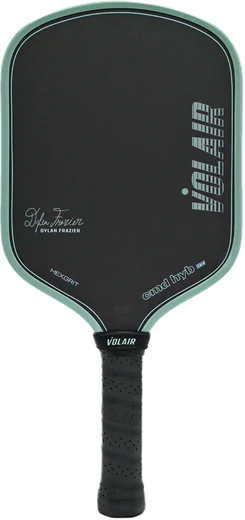
The Volair Mach 2 Forza is a soft widebody from late 2023, and its 16mm version still has the most control of any paddle I've tested. It's the paddle for you if your own dinks and resets cost you more points than the other team does. It scored a perfect 100 for control, and nothing that's come out since has caught it, not even the new foam core paddles. So on the court, the ball goes where you aim it and your soft shots die in the kitchen, even when your swing is a little off. Volair also makes a thinner 14mm, but it trades a good bit of control for a swing that's only a bit lighter.
The catch is power, and it's a big one. Only eight paddles on the market hit softer than the 16mm, so you'll win points by building them, not by blasting a drive past somebody. The spin is only about average for a widebody too, because the face is plain raw carbon with no grit on it. It's $108 with my code STSPICKLEBALL.
Every version, side by side
| Out of 100 | Mach 2 Forza 14mm$107.99 with code · widebody | Mach 2 Forza 16mm$107.99 with code · widebody |
|---|---|---|
| 8F | 34FLeads by 26 | |
| 68B | 64C | |
| 64C | 63C | |
| 83A | 91SLeads by 8 | |
| 81A | 100SLeads by 19 | |
| lower is quicker | 106.6 | 110.1 |
| higher is steadier | 6.83 | 7.24 |
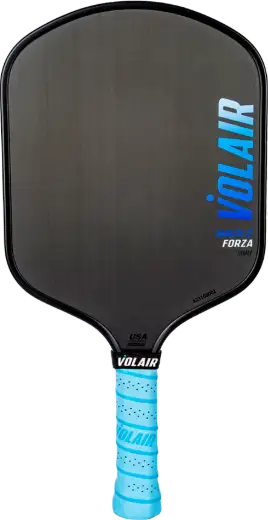
Mach 2 Forza 14mm
$107.99with code STSPICKLEBALL
list price $119.99Code STSPICKLEBALL takes 10% off, and my link applies it for you.
Mach 2 Forza 16mm
$107.99with code STSPICKLEBALL
list price $119.99Code STSPICKLEBALL takes 10% off, and my link applies it for you.
Pros and cons
Pros
- The 16mm has more control than any paddle I've tested, so dinks, drops and resets land short and low.
- The 16mm's big sweet spot and steady face keep your mishits in play.
- Its soft, plush face makes a hard speedup easy to block.
Cons
- If you like to end points with big drives and put-aways, you'll have to supply most of the pace yourself.
- If spin is a big part of your game, the raw carbon face only spins like an average widebody.
Quick answers
Is the Mach 2 Forza good for beginners?
Yes, the 16mm is one of the best I've tested for a newer player. It cuts down on unforced errors, because the ball stays low and goes where you aim it. On my beginners list it's second, right behind the original Pegasus Jelly Bean, a widebody that plays a lot like it for $18 less.
Should I get the 14mm or the 16mm?
The 16mm. The 14mm gives up a good bit of control, a lot of power and a bit of sweet spot, and all you get back is a swing that's a bit lighter.
Is the CTRL 2 Forza the same paddle?
No, it's a different paddle. It's a widebody Volair released the fall after this one came out, with an aramid fiber face, and it lists at $140. It isn't in my current rankings, so I can't put numbers next to it.
Can I use it in tournaments?
Yes. Volair lists it as USA Pickleball approved, so it's good for sanctioned tournaments as well as your local club.
How I tested
I tested this paddle the same way as every other one in my collection. In October 2026 I retested all of them with a new scoring system, so an older paddle like this one gets scored exactly the way this year's paddles do. My Stalker Pro 3S radar reads the ball speed behind my power scores and the spin on my serves. My Briffidi SW1 tells me how much heft you'll feel out at the head when you swing, and how well the face holds still when you catch a ball off center. Sweet spot and control are rated from my ball machine drills, where I hit dinks, drops and resets and score how the paddle handles them. When I rank a paddle on this page, I'm counting the paddles you can buy right now.
This one isn't new to me, either. I first reviewed it when it came out at the end of 2023, and the next fall I named the 16mm my top control paddle of the year.
How it feels in your hand next to other widebodies you can buy
About average in your hands, steadier than most when you miss the middle
How heavy the paddle feels when you swing it. Lower means faster hands.
About average swing weight for a widebody.
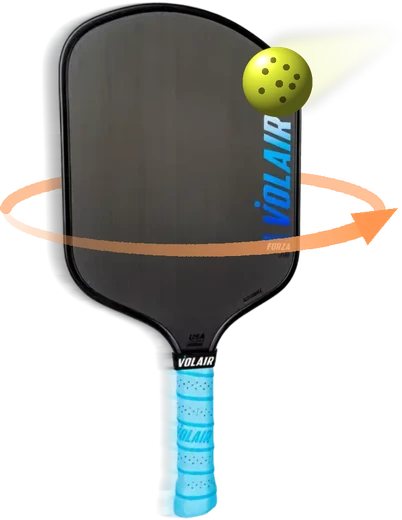
How well the paddle resists turning in your hand when you hit off center. Higher means steadier.
Only five widebodies you can buy are steadier.
How its sweet spot stacks up against other widebodies you can buy
Only six widebodies you can buy have a bigger sweet spot
Both rings are sized to their score.
What the 16mm feels like at the kitchen
When somebody drives a ball at your feet, this paddle takes the pace off it without you doing much. You just get the paddle there and the ball drops into the kitchen. And because the ball comes off the face slow, your dinks and drops stay low instead of floating up for the other team to attack.
It's also really predictable. When I first played it, where I thought the ball would go was exactly where it went, and that's what a perfect control score feels like. And a year later, when I rushed into a return of serve or flicked a speedup a little too hard, those balls were still staying in more often than with any other paddle I'd used.
Its sweet spot backs that up. It's a bit bigger than the average widebody's. Across every paddle you can buy, only six have a bigger one. It's also steadier than most widebodies when you catch the ball off center, so a dink off the edge doesn't twist the face open and sit up.
What you give up: power, spin and reach
How its spin stacks up against other widebodies you can buy
Less spin than most widebodies, 26 RPM below the average
The top three for spin
- 1Honolulu J3CR Crystal Blue2,436
- 211SIX24 Pegasus Jelly Bean 22,37561 RPM behind
- 3RPM Q2 Widebody2,36967 RPM behind
- 31Volair Mach 2 Forza2,247189 RPM behind
When you get a high ball at the net with the Mach 2 Forza, you have to swing through it to put it away, because a quick punch doesn't make the ball jump off the face. That jump is pop, and this paddle has a good bit less of it than the average widebody. Power on drives is a lot lower too. Only three widebodies hit softer than the 16mm, and one of those is its own 14mm. So you won't win many points with one big drive or serve, and if you like to finish from the baseline, you'll miss the pace.
In my first review, I played it both stock and with lead tape and liked it about equally. My advice back then was to keep it stock if you value hand speed. If you wanted a bit more power on drives and a bit more stability on resets and in hands battles, my setup was one 5 inch strip of lead tape on each side, starting an inch out from the handle and going up the sides of the throat.
The spin shows its age, too. When it came out, this paddle was known for its spin, and today it spins about the same as the average widebody on my serve test. I haven't wear tested this face, so I can't promise how long its spin lasts.
The last thing you give up is reach. A widebody is shorter than a hybrid or an elongated paddle, so it's harder to get to balls out wide, and harder to reach up and attack a high ball.
Which thickness to get
Volair pitches the 16mm as the softer one and the 14mm as the one to let fly, but on my scores the 16mm actually hits harder, and the pop is about the same on both. Back when I first tested them, I preferred the thicker one. The thinner one had great hand speed, but I didn't want to give up that much sweet spot for it.
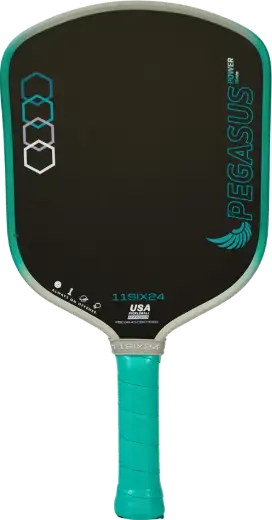
Both thicknesses cost the same, and at that price the 14mm runs into a paddle that scores higher for less. 11SIX24's first Pegasus Power is a $90 widebody, and it beats the 14mm on power, pop, spin, sweet spot and control. It swings heavier, though, and the lighter swing is the whole reason to get the 14mm.
Volair still sells the original Mach 2, the paddle that came before this one. That one is cold pressed instead of heat molded in one piece, with no foam around the edge. In 14mm, the older paddle scores about the same as the Forza version, with a bit less pop, and it swings even lighter for $63. The catch is that it's less steady than most widebodies when you miss the center. If a light swing is what you're after and you can live with that, it's the better buy.
What owners are saying
Volair's own store shows 463 reviews for it, and most of them are five stars. In early November 2026, I read ten owner reviews and testimonials there, plus the four Tennis Warehouse reviews of the thinner one.
Five of those fourteen owners brought up control. One called it "the answer to beating bangers", another said they had better control and more confidence on drop shots, and two on Tennis Warehouse found the 14mm easy to move around and good for placing the ball. One 14mm owner on Volair's store also called the sweet spot enormous.
Most of the complaints are about power. One owner says it's good "unless you want a cannon", a three star review of the 14mm says it lacks power, and another owner of the thinner one added weight to the sides to get more controlled power out of it. One more wished Volair had put a durable grit on it. I didn't find a single report of cracking or the face coming apart. If you buy from Volair, it has a one year warranty against defects, and if it's unused or lightly used, you can send it back within 15 days of delivery for a refund, minus a $20 fee and your return shipping.
Other paddles to look at
Two paddles you might pick instead
How it stacks up against the Pegasus Jelly Bean and the Pegasus Jelly Bean 2
A paddle only wins a score when it leads by 5 points or more.
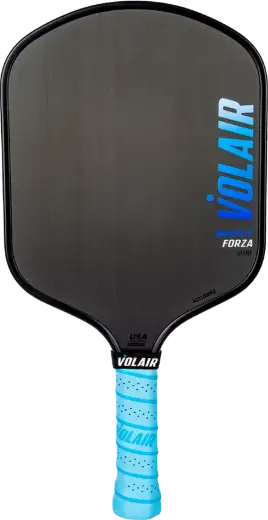 Mach 2 ForzaWidebody · $107.99
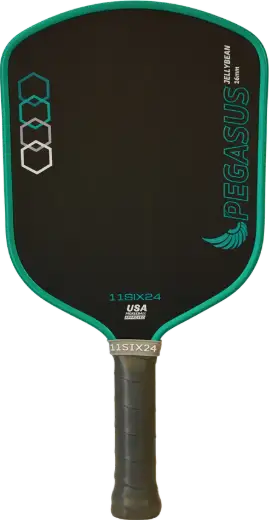 Pegasus Jelly BeanWidebody · $89.99
The Mach 2 Forza has more pop and is more controllable. Power, spin and sweet spot are about the same. The Pegasus Jelly Bean costs about $18 less.
Mach 2 ForzaWidebody · $107.99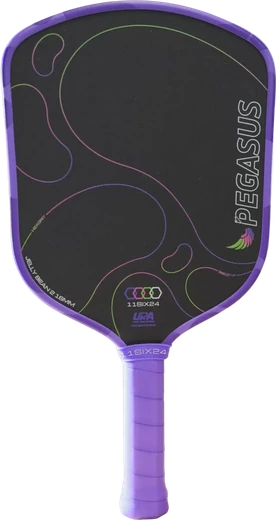 Pegasus Jelly Bean 2Widebody · $159.99
The Mach 2 Forza is more controllable. The Pegasus Jelly Bean 2 hits harder, has more pop and spins more. Sweet spot is about the same. The Pegasus Jelly Bean 2 costs about $52 more.
All three of these take my code STSPICKLEBALL, and the prices below are with it.
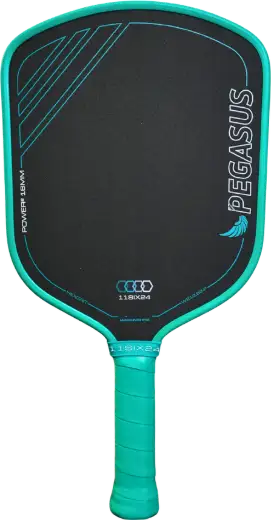
11SIX24 Pegasus Jelly Bean: almost the same for less
The original Pegasus Jelly Bean is 11SIX24's control widebody, built like this paddle with a honeycomb core and foam around the edge, and on my scores it's the closest paddle to the 16mm Mach 2 Forza. Next to the Mach 2 Forza, the Jelly Bean gives up a bit of control and a bit of pop and isn't quite as steady on mishits, but it does swing a bit lighter. Sweet spot, power and spin are all about the same. At $90 it costs less, which is why I put it one spot ahead on my beginners list. Pay the extra if you want every last bit of control, and get the Jelly Bean if you'd rather keep the money.
11SIX24 Pegasus Jelly Bean 2: a lot more spin, less control
The Pegasus Jelly Bean 2 is the newer version of the original Pegasus Jelly Bean, with an all foam core instead of honeycomb and 11SIX24's HexGrit face. I'd buy it if you want a lot more spin and can live with a good bit less control. Next to the 16mm Mach 2 Forza, it also hits a lot harder and has a bit more pop, with the same size sweet spot. That spin should hold up, too, because after 75 games of my wear test, HexGrit had lost only about 1% of it. You'll pay $160 for it. It isn't USA Pickleball approved, so you can't use it in USA Pickleball sanctioned tournaments. It's UPA-A approved, which PPA and MLP pro events use, and most local leagues and clubs accept it.
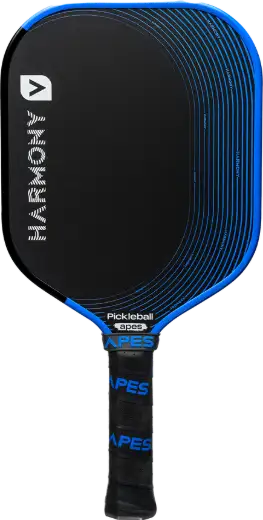
Pickleball Apes Harmony V: elite control for the least money
The Harmony V is Pickleball Apes' control widebody, and at $72 it's the cheapest paddle with control over 90. Its control is a bit lower than the 16mm Mach 2 Forza's, and its sweet spot, spin and steadiness on off-center hits are all about the same. It hits a good bit harder. What you give up is a lot of pop, so put-aways take more work, though your soft shots stay down.
My call
For pure control, nothing beats the Mach 2 Forza 16mm, and I'd buy it if you lose more points to your own mistakes at the kitchen than to the other team's winners. It keeps your dinks and resets low, it stays steady when you mishit, and it's still a fair price. Just go in knowing you'll supply your own power and the spin is only average now. If you'd rather save a little, the original Pegasus Jelly Bean plays almost the same for less, and if you want spin that lasts, I'd go with the Pegasus Jelly Bean 2, though its control drops a good bit. I'd skip the 14mm. If a lighter swing is what draws you to it, the original Mach 2 in 14mm gives you that for much less, though its face twists more on mishits.
Testing details
- Tested, Mach 2 Forza 14mm
- July 30, 2026
- Tested, Mach 2 Forza 16mm
- July 30, 2026
- Power and pop
- 20 full serves for power and 20 punch volleys for pop, every ball speed read on a Stalker radar gun.
- Spin
- 20 more serves on the radar. I drop the outliers and average the rest.
- Swing and twist weight
- Measured on a Briffidi SW1 swing weight machine.
- Sweet spot and control
- The same dinks, drops, resets and drives off a Titan ONE ball machine, for every paddle.
- The scores
- Out of 100, with the same tests for every paddle. The top paddles I've tested score 100.
- Published
- Updated
- Scores from
- My database, updated November 21, 2026. How I test
Watch the review
 6:21#1 HIGHEST SPINNING Paddle in 2024: Volair Mach 2 Forza Review
 No. 3
 No. 4
 No. 4